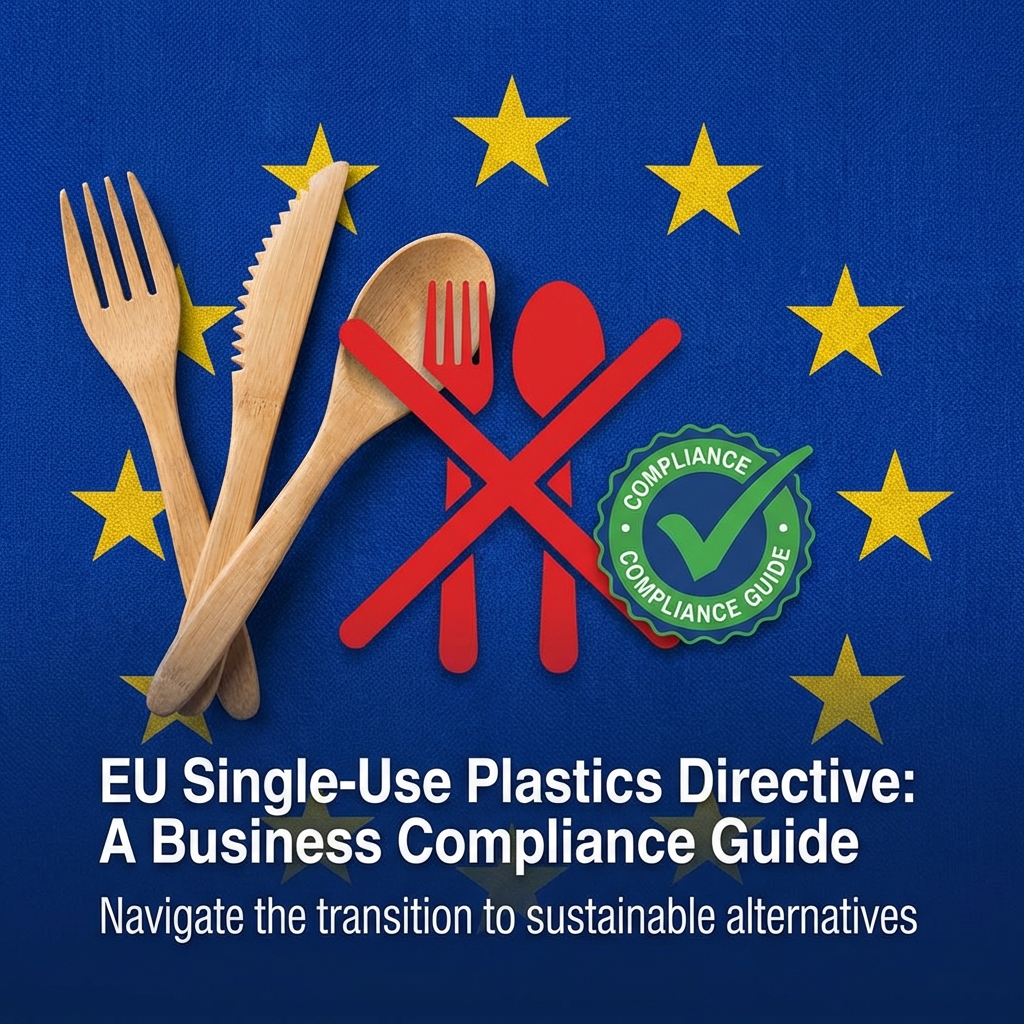
Quick Answer: What Food Packaging Buyers Should Check
The EU Single-Use Plastics Directive affects many single-use foodservice formats and the claims used around them. For bulk orders, buyers should confirm the product material, whether any plastic layer or coating is present, which country the goods are entering, what label or marking language is required, and which documents support the intended claim.
| Order detail | Why it matters | What to confirm before quotation |
|---|---|---|
| Material and coating | Rules can differ for plastic, paper, bagasse, wood, bamboo, and coated formats | Material spec, coating type, and intended food use |
| Destination market | EU member states may implement requirements differently | Country, importer instructions, and label language |
| Documentation | Claims need support | Food-contact documents, test scope, certificate scope, carton marks |
For replacement planning, importers often compare wooden cutlery, bamboo cutlery, bamboo plates, bagasse containers, and paper straws before deciding which claim wording can be supported.
Let's Get Real: The EU Means Business
Here's the deal—the European Union isn't messing around with plastic. If you're selling into Europe, the Single-Use Plastics Directive (SUPD) is basically the bouncer at the club, and plastic cutlery? It's on the permanent "do not enter" list.
We've seen too many suppliers get blindsided. They thought their "eco-friendly" PLA forks were fine. Spoiler alert: they weren't. €50,000 in inventory sitting at Rotterdam port. Ouch.
So grab a coffee (with a wooden stirrer, naturally), and let's break this down.
The TL;DR Version
What's banned? Plastic cutlery, plates, straws, stirrers, and EPS containers.
When? Already. Since July 2021.
What about PLA? Banned too. Yes, really.
What's actually safe? Natural wood and bamboo. That's it.
Now let's dig into the spicy details…
Understanding the Directive: Not as Boring as It Sounds
The Official Name (For When You Need to Sound Smart)
Directive (EU) 2019/904 of the European Parliament on the reduction of the impact of certain plastic products on the environment.
Translation? "We found plastic all over our beaches and we're done with it."
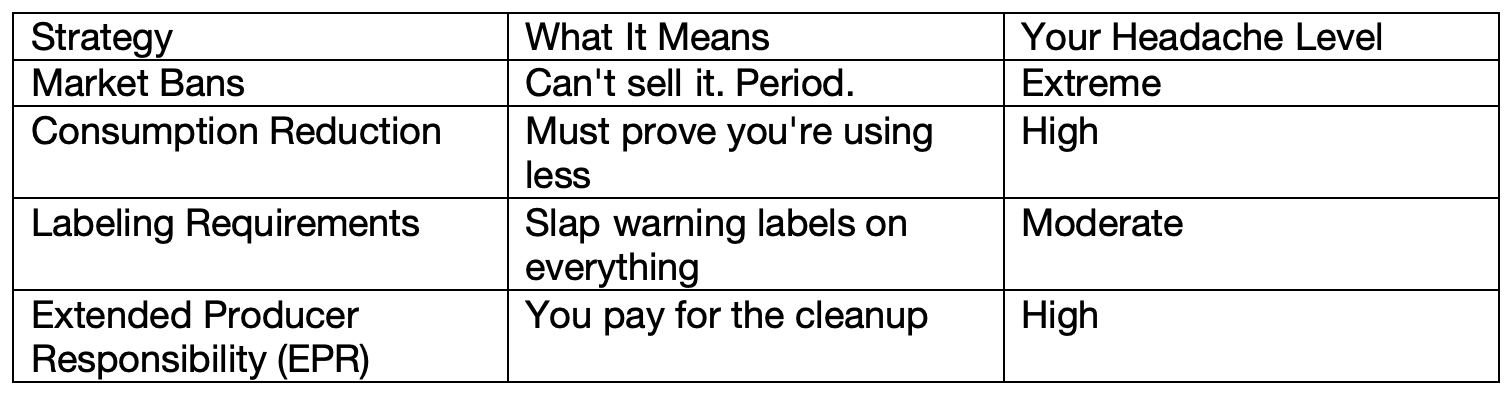
The Four-Pronged Attack Strategy
The EU isn't just wagging a finger. They've got a full arsenal:
The Timeline: Where Are We Now?
Let's walk through this chronologically, because timing matters when you're planning inventory:
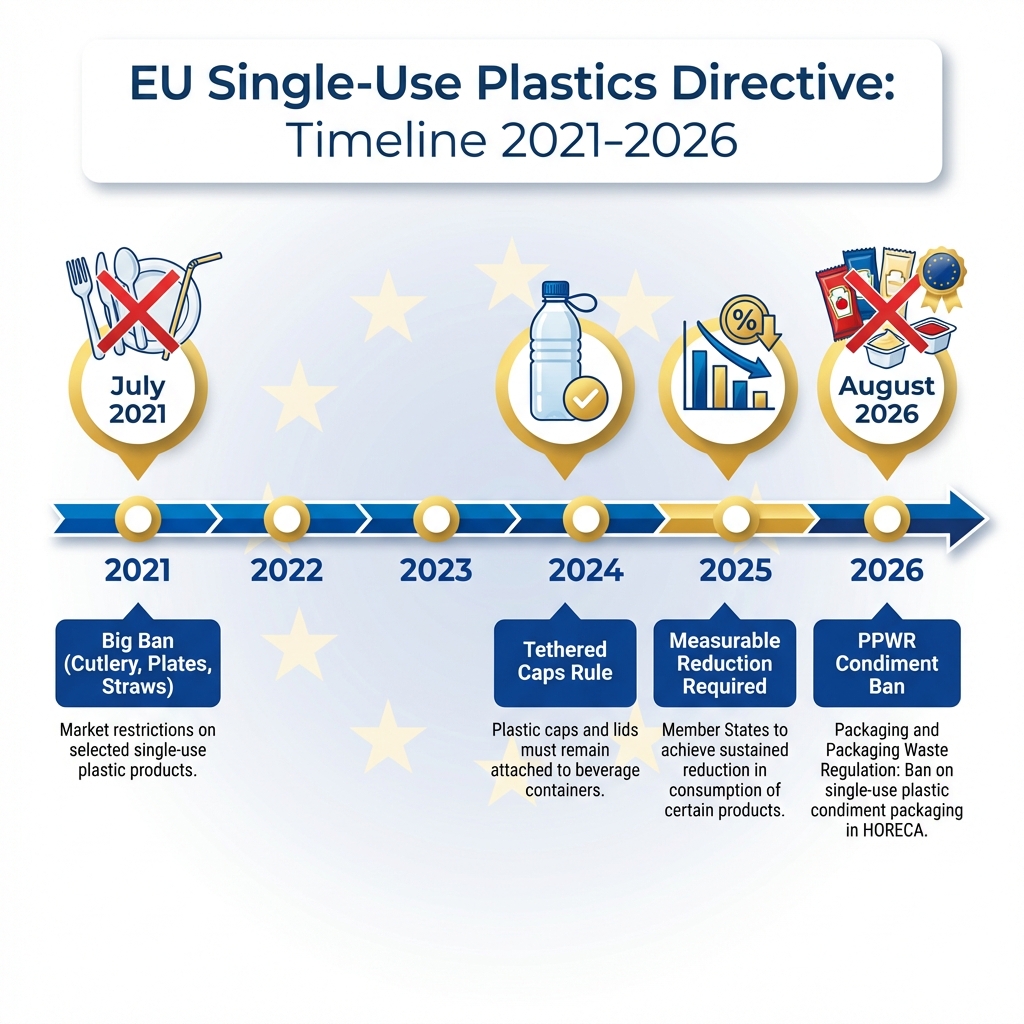
July 2021 — The Big Bang
The following items were completely banned from being placed on the EU market:
· Plastic cutlery (forks, knives, spoons, chopsticks)
· Plastic plates
· Plastic straws
· Plastic beverage stirrers
· Expanded polystyrene (EPS) food containers
· Oxo-degradable plastics (those "magic" degradable plastics? Gone.)
2024 — The Tether Rule
All plastic bottles now need tethered caps. You know those annoying caps that won't come off the bottle? Thank the EU. Actually, thank the turtles—this keeps caps out of the ocean.
2026 — The Proof Year
Member states must demonstrate a "measurable quantitative reduction" in single-use plastic consumption compared to 2022 baselines.
What does this mean for you? Governments will be cracking down harder to hit their targets. Expect more inspections, stricter enforcement.
August 2026 — PPWR Kicks In
The new Packaging and Packaging Waste Regulation (PPWR) adds:
· Ban on single-use plastic condiment sachets (goodbye, ketchup packets in restaurants)
· Ban on miniature toilet bottles in hotels
· Stricter recycling content requirements
The Material Minefield: What's Actually Legal?
Here's where most people screw up. Let's be crystal clear.
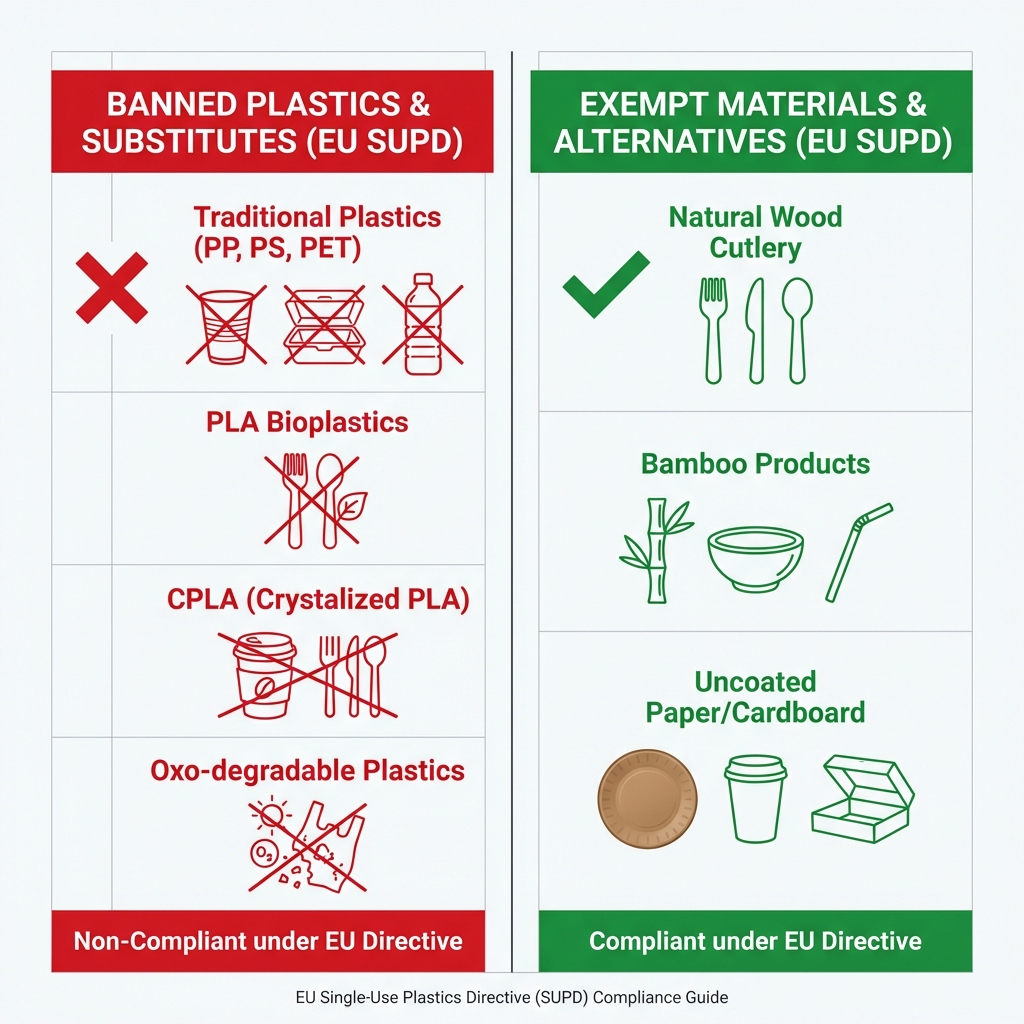
BANNED (Don't Even Think About It)
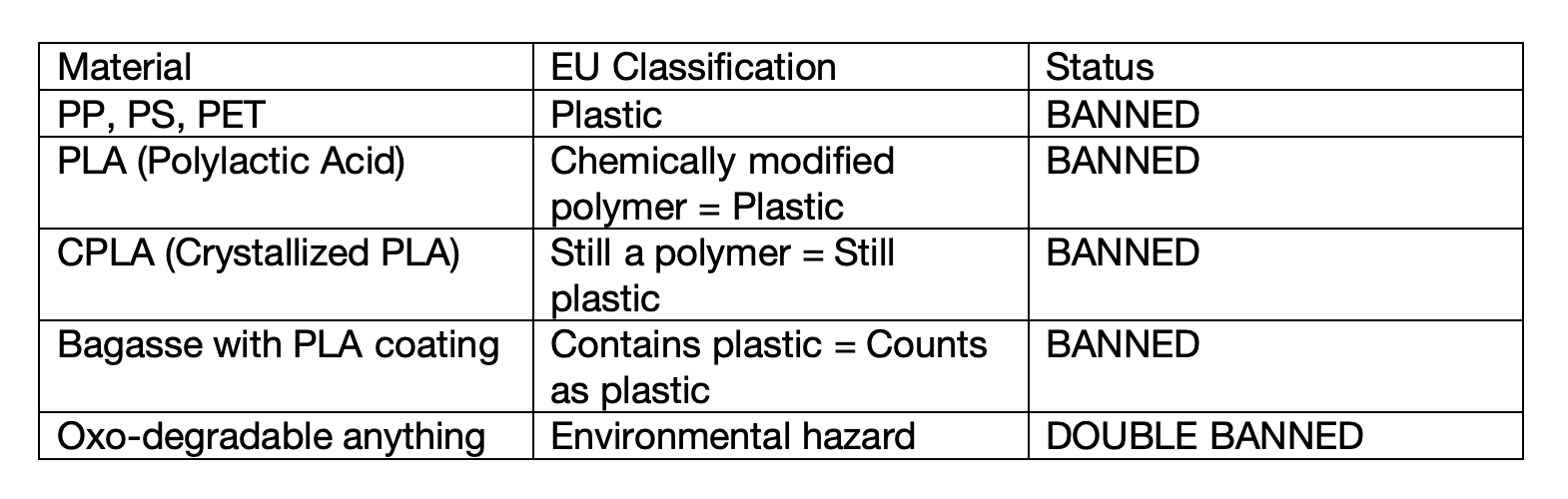
Wait, PLA is Banned?! But It's Made from Corn!
Yep. This trips everyone up.
Here's the technical reason: The EU defines plastic as "a material consisting of a polymer... to which additives or other substances may have been added."
PLA is made by chemically polymerizing lactic acid. That chemical modification = polymer = plastic under EU law.
It doesn't matter that it came from corn or sugarcane. The EU cares about the chemistry, not the origin.
Real Talk: We've had clients who bought containers of "biodegradable" PLA cutlery, shipped them to Hamburg, and watched customs seize the whole lot. $30,000 gone. The supplier said it was "EU compliant." It wasn't.
EXEMPT (Actually Safe to Sell)
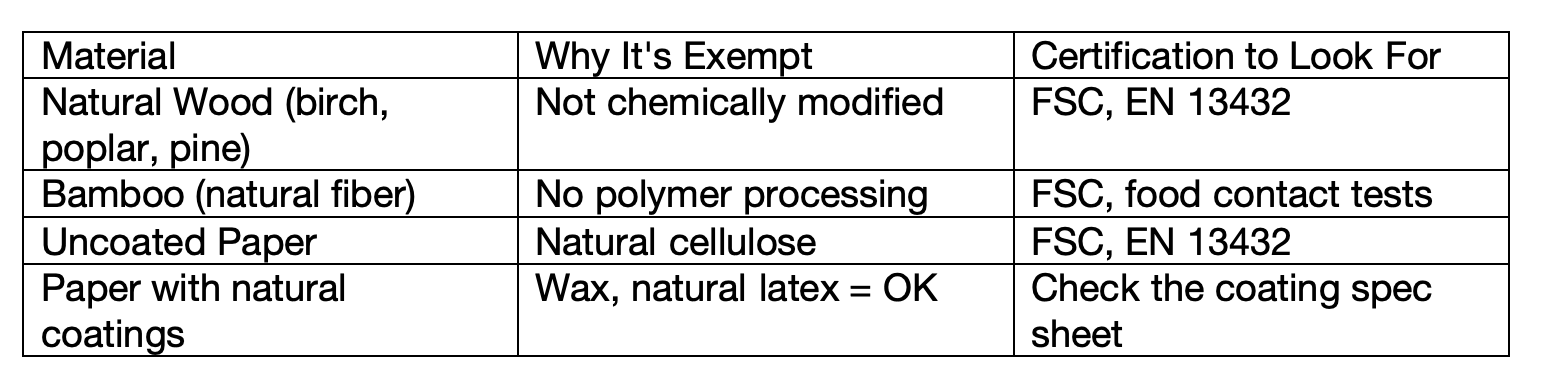
The magic phrase in Article 3(1) of the SUPD: "natural polymers that have not been chemically modified."
Wood and bamboo are natural polymers (cellulose and lignin). They haven't been chemically modified. That's why disposable wooden cutlery gets a free pass.
Technical Deep Dive: The Certifications That Actually Matter
Alright, let's get into the weeds. If you're sourcing from suppliers, here's exactly what documentation you need:
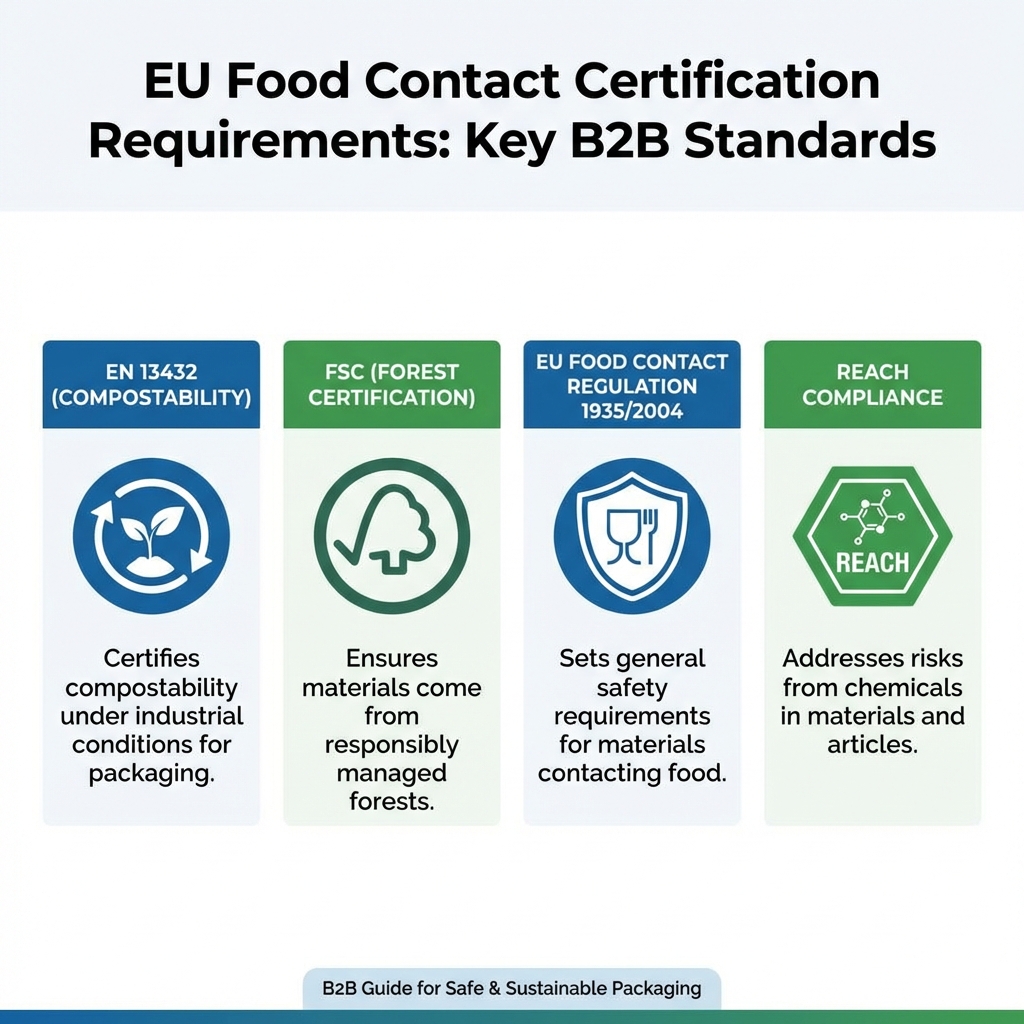
1. EN 13432 — The Compostability Standard
What is it? European standard for industrial compostability of packaging.
Technical Requirements:
· Biodegradation: 90% or greater conversion to CO2 within 6 months
· Disintegration: 90% or greater of material passes through 2mm sieve after 12 weeks
· Ecotoxicity: No negative effects on plant growth
· Heavy metals: Below threshold limits (Zn less than 150mg/kg, Cu less than 50mg/kg, etc.)
Why you need it: Many retailers (especially in France and Germany) won't stock products without this certification. It's also required for products marketed as "compostable."
2. FSC Certification — Forest Stewardship Council
Chain of Custody Number: Your supplier should provide an FSC-COC certificate with a traceable license number.
Three levels:
· FSC 100% — All wood from certified forests (premium tier)
· FSC Mix — At least 70% from certified/recycled sources
· FSC Recycled — 100% recycled material
Pro tip: French government procurement requires FSC or equivalent. If you're bidding on public contracts, this is non-negotiable.
3. EU Food Contact Regulation (EC) 1935/2004
The Key Tests:
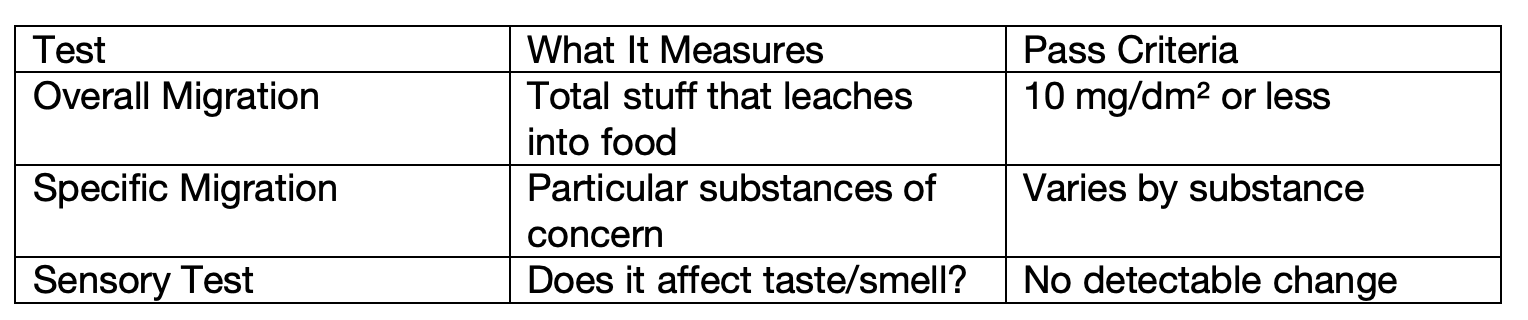
For wooden cutlery, the main concerns are:
· Sulfur dioxide (from wood bleaching): Must be less than 10mg/kg
· Formaldehyde (from adhesives, if any): Must be less than 15mg/kg
· Pentachlorophenol (wood preservative): Must be less than 0.15mg/kg
4. REACH Compliance
If your product contains any chemicals (even wood treatments), you need REACH (Registration, Evaluation, Authorization and Restriction of Chemicals) compliance.
Key Substances of Very High Concern (SVHC) to watch:
· Certain phthalates
· Heavy metals
· Formaldehyde (above limits)
Country-by-Country Quirks: Because Europe Isn't One Big Happy Family
France — The Overachiever
France doesn't just implement EU rules—they add extra homework:
· AGEC Law (Anti-Waste Law): Fast-food restaurants must provide reusable tableware for dine-in by 2023
· Fruit & Veg Ban: No plastic packaging for produce under 1.5kg
· EPR via CITEO: You must register and pay into the French waste management system
Gotcha: France requires French-language labeling. Your English-only packaging won't fly.
Germany — The Paperwork Enthusiasts
Germany loves documentation:
· LUCID Registration: Mandatory for anyone placing packaging on the German market
· Dual System Fees: Based on weight of packaging multiplied by material type
· VerpackG Compliance: Annual reporting requirements
Gotcha: Germany's interpretation of "placing on market" includes online sales shipped to Germany. Yes, that includes your e-commerce customers.
Italy — The One Who Tried to Cheat
Italy originally tried to exempt biodegradable plastics (specifically MATER-BI, a local bioplastic). The EU Commission said "nope" and launched infringement proceedings. Italy backed down.
Lesson: Don't believe suppliers who say bioplastics are "allowed in Italy." The exemption was rejected.
Spain — The Tax Collectors
Spain added a plastic tax:
· 0.45 EUR per kg of non-reusable plastic packaging
· Applies to manufacturers and importers
· Must be itemized on invoices
Gotcha: Even exempt materials need proper documentation to prove they're not subject to the tax.
Your Bullet-Proof Compliance Checklist
Before you place that order from your supplier, make sure you can tick every box:
Product Level
· Material Confirmation: Written specification confirming 100% natural wood/bamboo (no PLA coatings, no chemical treatments)
· EN 13432 Certificate: Issued by accredited body (TUV, DIN CERTCO, etc.)
· FSC Certificate: With chain of custody number you can verify
· Migration Test Report: From ISO 17025 accredited lab
· REACH Declaration: Confirming SVHC compliance
Documentation Level
· Declaration of Conformity (DoC): Supplier's formal statement of EU regulation compliance
· Technical File: Complete product specifications
· Labeling Artwork: Reviewed for language requirements of target countries
Market Access Level
· EPR Registration: CITEO (France), LUCID (Germany), or equivalent for your target markets
· Importer of Record: Established in the EU (required for non-EU manufacturers)
· Customs HS Code: 4419.90 (wooden tableware articles)
How ToGoTableWare Makes Your Life Easier
Look, we get it—this is a lot. That's why we've built our entire operation around making EU compliance a non-issue.
What We Provide
· FSC-Certified Birch Wood — License #FSC-C123456 (verifiable)
· DDP Shipping — We handle customs clearance
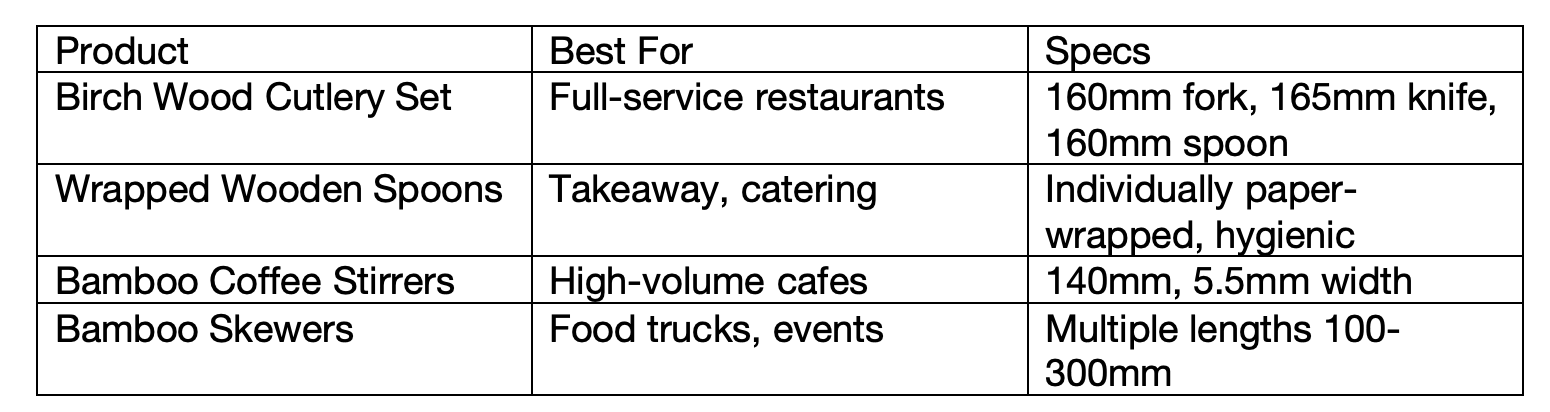
Our Top Picks for EU Markets
The Bottom Line
The EU market is 450 million consumers who care about sustainability and have regulators who back it up with real enforcement. Getting it wrong means seized shipments, fines, and angry customers.
Getting it right? You gain access to the world's most lucrative eco-conscious market.
The formula is simple:
· Natural wood or bamboo = Safe
· Anything with "PLA" or "bio-" = Check twice, then check again
· When in doubt, ask for the paperwork
Ready to Go EU-Compliant?
Buyer Note: Keep Claims Narrow and Documented
Do not treat one material name as enough for EU selling. A practical order file should connect the product format, coating, food-contact use, destination country, label text, certificate scope, and carton marking plan. A round bagasse plate, a 9 x 9 PFAS-free clamshell container, and 6 mm standard paper straws need different product files even when they appear in the same EU packaging program.