Understanding the Basics
When sourcing bio based straws, it's helpful to clarify what the term actually means: drinking straws made wholly or partly from biological or plant-derived inputs. The term "bio-based" describes the material's origin, not its end-of-life behavior. Crucially, it does not automatically prove compostability, biodegradability, or local disposal acceptance. Like conventional options, each finished straw SKU still needs its own rigorous specification, sample testing, packing detail, and claim review.
For TOGO, the most productive starting point is not a broad promise that one eco friendly drinking straws option is universally greener than another. Instead, we focus on the realities of the finished straw program: the specific beverage, expected service time, cup and lid configuration, straw diameter, packing style, carton mark, and destination market. While bio-based material names help narrow the range of choices, they do not replace the need for physical sample testing or proper claim evidence. This practical approach explains why the same beverage group might use PLA for their iced coffee, PHA for premium hotel service, and paper for a short-use breakfast counter, correctly recognizing that no single material is a universal fit for every scenario.
The Comparison Table: Six Material Families Side by Side
This is the table we wish every buyer had before their first call. It covers what each material does well, where it struggles, and which drink scenarios we've seen it succeed in.
| Material | Strong Fit | Real Drink Scenarios | Watch Out For | Price Tier | TOGO Starting Point |
|---|---|---|---|---|---|
| PHA | Premium bio-based programs, marine-biodegradable positioning | Hotel room service, premium juice bars, resort minibars | Product-level evidence still required for specific biodegradation claims | $$$ | PHA Straws Wholesale |
| PLA | Cold drinks needing smooth, plastic-like mouthfeel | Iced coffee, cold-pressed juice, smoothie bars, boba (cold) | Not suited for hot drinks; compostability requires commercial facility and evidence | $$ | PLA Straws Wholesale |
| PBS | Selected bio-based programs with specific performance needs | Emerging use in specialty cold beverages | Less market familiarity; fewer established claim pathways | $$ | PBS Bamboo Powder Straw |
| Paper | Short-service cold drinks, cost-sensitive programs | Fast-food fountain drinks, cafeteria self-serve, event catering | Softens in 20–40 minutes; coating type affects recyclability claims | $ | Main straw category |
| Bamboo | Natural presentation, hospitality and specialty retail | Hotel welcome drinks, resort cocktails, spa beverages | Higher unit cost; different texture; limited diameter options | $$–$$$ | Bio-Based Straws Wholesale |
| Wheat | Natural-fiber look, rustic presentation | Farm-to-table restaurants, craft cocktail bars, tasting events | Inconsistent diameter; shorter shelf life; limited scalability | $–$$ | Bio-Based Straws Wholesale |
Selecting the Right Material for the Right Drink
When purchasing plant based straws bulk, buyers often realize that a single material cannot perfectly cover every beverage on their menu. For instance, a hotel group we partner with successfully utilizes three entirely different straw materials across their property. They deploy paper straws for the breakfast buffet (10-minute use), PLA for the lobby cafe (30–45 minute use), and PHA for room service (up to an hour). That represents three distinct materials, three different packing formats, and three separate price points all operating efficiently under one brand, driven strategically by actual drink demands.
 Different beverages—such as iced coffee, fruit tea, smoothies, cocktails, and boba—create distinctly different demands. Iced drinks require a pleasant mouthfeel and a secure lid fit. Thick smoothies demand excellent flow and collapse resistance. Boba necessitates a wider bore and strong film puncture capabilities. Meanwhile, hotel service prioritizes individual wrapping and clean visual presentation. Recognizing that a single material cannot perfectly optimize for all of these varied requirements is the key to building a successful, durable beverage program.
If Your Main Drink Is ___, Start Here
Not sure which material family to sample first? This decision tree covers the most common starting points we see:
- Iced coffee or cold-pressed juice → Start with PLA. Smooth feel, holds up for 45+ minutes in cold drinks. Test 6 mm or 8 mm diameter.
- Boba or thick smoothie → Start with PLA at 12 mm diameter. Check film puncture if your cups use sealed tops.
- Hot drinks → Paper is often the first material to review. Ordinary cold-drink PLA should not be assumed suitable for heat.
- Premium hotel or resort service → Start with PHA. Individually wrapped, strong bio-based positioning. Test PHA Sugarcane Bagasse Straw or PHA White Straw.
- Fast-food or high-volume cafeteria → Paper at the lowest cost tier, or PLA if the program needs longer drink time.
- Farm-to-table or craft presentation → Wheat or bamboo for visual impact. Confirm diameter consistency meets your cup/lid setup.
- Distributor building a mixed catalog → Sample across PHA, PLA and paper to cover multiple end-use segments.
How We Organize Materials — And Why It Matters
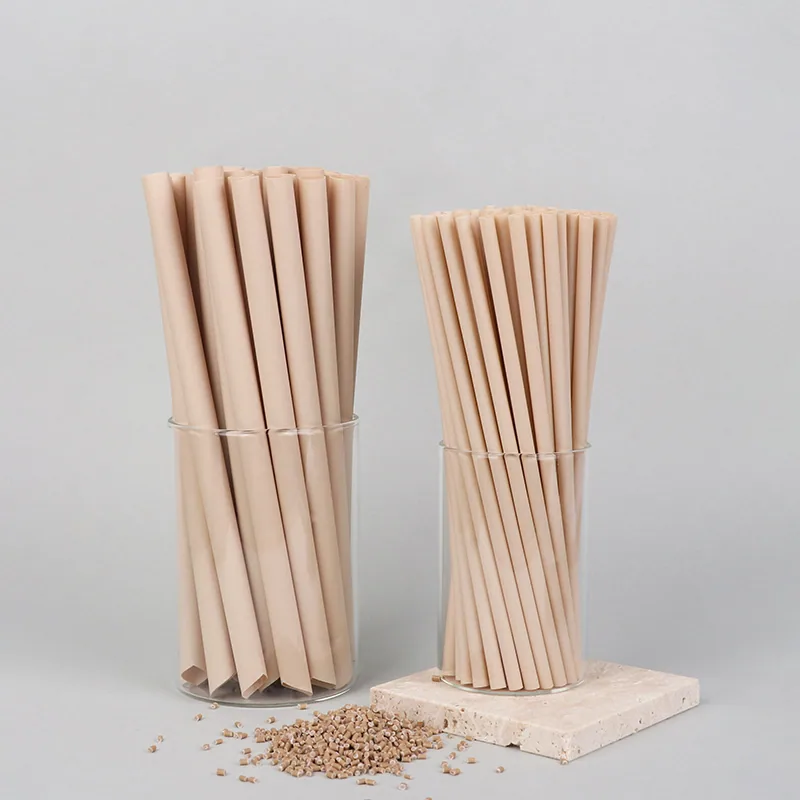
PHA bamboo powder straws, natural bamboo straws, PLA bamboo powder straws and PBS bamboo powder straws can all look nearly identical in a product image. They are different products — different cost, different claim pathways, different performance.
Our Bio-Based Straws Wholesale category introduces the full range. From there, each material family has its own page — PHA Straws, PLA Straws, individual products like PLA Translucent Sugarcane Bagasse Straw or PBS Bamboo Powder Straw. Material first, then drink use, then packing, then claim documentation. That sequence prevents a visual similarity from becoming a specification error.
Navigating Bio-Based and Compostable Definitions
Quick distinction we repeat in almost every buyer conversation:
- Bio-based = made from plant-derived inputs. Says nothing about what happens after use.
- Compostable = breaks down under specific composting conditions (usually commercial/industrial). Requires product-level test evidence, typically under ASTM D6400. See BPI's compostability certification program.
- Biodegradable = breaks down in some natural environment. Vague without specifying conditions, timeframe and evidence.
The EPA clarifies that biobased and compostable plastics are not the same claim. The FTC's Green Guides set boundaries on how these terms can be used in marketing. We reference both when reviewing wrapper language and catalog copy with our buyers.
Navigating the Bio-Based Sourcing Journey
Transitioning to bio-based straws requires careful navigation of both performance and environmental claims. A critical first step is understanding that "bio-based" merely describes the material's origin; it does not automatically guarantee compostability. Real-world compostability depends entirely on the finished product's specific test evidence and the actual disposal infrastructure available in your target market. Consequently, you can only print compostability claims on your wrapper after confirming that the specific straw SKU's documentation strictly supports it. We systematically review all proposed wrapper language against this product evidence before printing and help guide you through relevant standards like ASTM D6400 or the FTC Green Guides.
From a performance standpoint, buyers often seek a "universal" solution. While PLA arguably covers the widest range of standard cold drinks, no single material perfectly optimizes for every single scenario. A fast-paced boba shop, a premium hotel service, a quick-service drive-thru, and a high-end cocktail bar all possess drastically different requirements. This is why testing is non-negotiable, and why TOGO regularly prepares multi-material comparison sample sets and comprehensive quotations for buyers managing diverse drink programs or multiple distribution channels.
We can help you transform a complex material comparison into a streamlined, quotation-ready shortlist. Simply reach out to the TOGO team with your detailed drink menu, cup and lid types, required straw sizes, packing preferences, destination markets, any planned claim language, and forecast quantities. Whether you lean toward our Bio-Based Straws Wholesale range, specifically PLA Straws Wholesale, or PHA Straws Wholesale, we will curate the perfect sample set, meticulously review the available documentation, and ensure you source the exact SKUs that elevate your beverage program.