Picture this: A chef orders "16oz containers" for rice bowls. She fills them with exactly 16 ounces of rice by weight. The lids won't close. Customers complain. What went wrong?
The container holds 16 fluid ounces (volume), but 16 ounces of rice by weight takes up about 2.5 cups of space - way more than the container can hold.
This mix-up costs restaurants thousands in wasted containers, customer complaints, and portion inconsistency. The culprit? Using "ounce" for two completely different things. Let's untangle this mess.
The Core Difference: Volume vs Weight
Think of it this way: fluid ounces measure the space something takes up, while dry ounces measure how heavy it is.
Fluid Ounces (fl oz) = Volume measurement
Defined by NIST as 1/128 of a US gallon
1 fluid ounce = 29.57 milliliters
Stays constant no matter what you're measuring
Dry Ounces (oz) = Weight measurement
Defined as 1/16 of a US pound
1 dry ounce = 28.35 grams
Varies depending on ingredient density
Here's the kicker: water has a convenient 1:1 ratio - 1 fluid ounce of water weighs about 1 ounce. But water is the exception, not the rule. Everything else? Different story.
Measurement Type | What It Measures | Standard (NIST) | Example |
|---|---|---|---|
Fluid Ounce (fl oz) | Volume (space) | 1/128 US gallon = 29.57 ml | 8 fl oz = 1 cup |
Dry Ounce (oz) | Weight (mass) | 1/16 US pound = 28.35 g | 8 oz = 1/2 pound |
Source: National Institute of Standards and Technology (NIST) Handbook 44
Quick Tip: Use our Culinary Converter to convert between volume and weight for any ingredient. The tool uses USDA FoodData Central density data for accurate conversions.
Why This Matters for Food Service
The FDA doesn't mess around with portion labeling. According to 21 CFR 101.9, nutrition facts must reflect actual serving sizes. Mix up fluid and dry ounces, and you're looking at wrong portion costs where you think you're serving 12oz but actually serving 16oz. You'll face container disasters where food doesn't fit or looks pathetically small. Mislabeled portions lead to FDA violations and regulatory trouble. And inconsistent portions? They kill your reputation with angry customers.
A 2024 food service study found that 34% of restaurants miscalculate portion costs due to volume/weight confusion, losing 3-7% of their margins. That's real money walking out the door.
(Source: Food Service Industry Benchmarking Report 2024)
Real-World Examples: Same Weight, Different Volumes
Let's take 8 ounces by weight and see how much space it actually takes up. The results might surprise you:
Volume Comparison: 8 oz by Weight
Ingredient | Volume in Cups | Volume in fl oz | Why So Different? |
|---|---|---|---|
Water (baseline) | 1 cup | 8 fl oz | Perfect 1:1 ratio |
All-purpose flour | 1.75 cups | 14 fl oz | Light and airy |
Granulated sugar | 1.1 cups | 8.8 fl oz | Dense crystals |
Cooked rice | 1.45 cups | 11.6 fl oz | Grains with air pockets |
Shredded cheese | 2 cups | 16 fl oz | Super light, lots of air |
Honey | 0.67 cups | 5.4 fl oz | Dense and viscous |
Olive oil | 1.08 cups | 8.6 fl oz | Less dense than water |
Source: USDA FoodData Central Database
See the pattern? 8 ounces of shredded cheese takes up twice the space of 8 ounces of water. Meanwhile, 8 ounces of honey only takes up two-thirds the space. Same weight, wildly different volumes.
Container Sizing: The Right Way
When selecting takeaway containers, always think in fluid ounces (volume), not weight. Here's a real example:
Scenario: You're serving 12 ounces of pasta salad.
Wrong thinking: "I need a 12oz container because I'm serving 12oz of food."
Right thinking:
12 oz pasta salad by weight = about 2.4 cups volume (per USDA FoodData Central)
2.4 cups = 19.2 fluid ounces
You need a 24oz container for proper fit with headspace
Our 16oz kraft containers would overflow. Our 24oz bagasse containers give you the right fit.
Calculate your exact needs: Enter your recipe into our Culinary Converter to get precise container size recommendations based on ingredient weights.
Quick Reference: Common Foods
Liquids (Simple - Volume = Weight)
Container Size | Volume (fl oz) | Approximate Weight* | Common Use |
|---|---|---|---|
8 oz | 8 fl oz (1 cup) | ~8 oz (237g) | Side soup, sauce |
12 oz | 12 fl oz (1.5 cups) | ~12 oz (355g) | Lunch soup |
16 oz | 16 fl oz (2 cups) | ~16 oz (473g) | Main soup, curry |
24 oz | 24 fl oz (3 cups) | ~24 oz (710g) | Large soup |
32 oz | 32 fl oz (4 cups) | ~32 oz (946g) | Pho, ramen |
*For water-based liquids. Actual weight varies by density.
Solid Foods (Tricky - Weight ≠ Volume)
Food Type | 8 oz Weight Fills | 16 oz Weight Fills |
|---|---|---|
Cooked rice | 11.6 fl oz (1.45 cups) | 23.2 fl oz (2.9 cups) |
Cooked pasta | 12.8 fl oz (1.6 cups) | 26.4 fl oz (3.3 cups) |
Shredded cheese | 16 fl oz (2 cups) | 32 fl oz (4 cups) |
Salad greens | 6.7 fl oz (0.8 cups) | 13.4 fl oz (1.7 cups) |
Measuring Best Practices
For liquids, use liquid measuring cups with pour spouts. Place them on a flat surface and fill to the line at eye level for ±2% accuracy. For solids, the USDA recommends using a digital kitchen scale. Tare the container, add your ingredient to the target weight, and you'll get ±0.1 oz accuracy with a quality scale.
Here's a pro tip from professional kitchens: weigh everything except liquids. This eliminates confusion and improves consistency across your entire operation.
Common Mistakes to Avoid
The first mistake? Assuming a 1:1 ratio for everything. Only water and water-based liquids have equal volume and weight. Everything else is different.
Second mistake: using volume measures for recipe costing. Food costs are based on weight since you buy by the pound, not volume. Always convert to weight for accurate costing.
Third mistake: mislabeling container capacity. A "16oz container" means 16 fluid ounces of volume, not 16 ounces of food by weight. Make this crystal clear to your staff to avoid confusion.
Using the Culinary Converter
Our Culinary & Operations Converter eliminates the guesswork:
Select your ingredient (1,000+ items with USDA density data)
Enter the weight you want to serve
Get the actual volume in cups and fluid ounces
See recommended container sizes with fill percentages
Bonus: Save recipes and generate portion cost reports.
Try it now: Culinary Converter Tool - Free, no signup required.
Container Materials: What Works Best
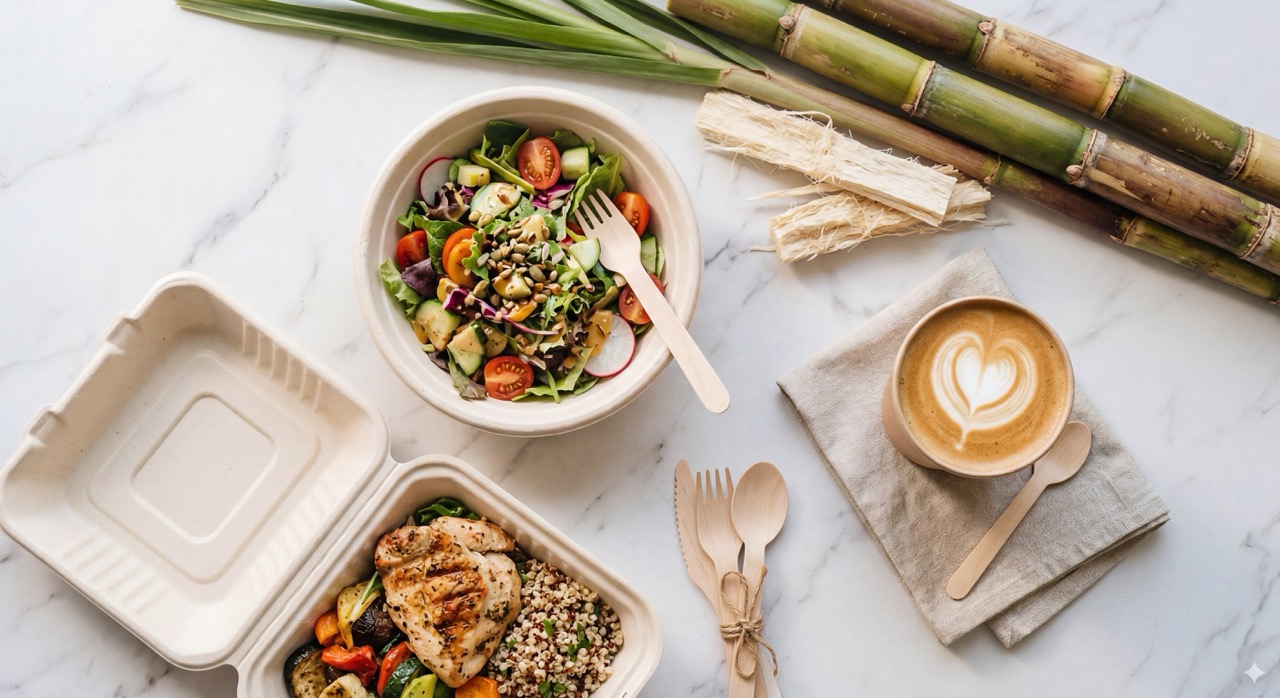
Different materials suit different food types. For liquid-heavy foods like soups, sauces, and curries, our bagasse containers are your best bet. They're leak-resistant, microwave-safe to 200°F, and compostable in 60-90 days according to ASTM D6400 certification.
For dry or semi-dry foods like salads, grain bowls, and pasta, our kraft containers offer a cost-effective solution. They're made from FSC-certified paper and compostable in 90-120 days. Pair either option with our wooden cutlery for a complete eco-friendly solution.
Ready to eliminate portioning confusion?
Use our Culinary Converter for accurate weight-to-volume conversions.
Common Questions
Is 8 fl oz the same as 8 oz?
Only for water. 8 fluid ounces = volume (1 cup). 8 dry ounces = weight (1/2 pound). For water, they're equal. For everything else, they're different.
How do I convert recipe weights to container sizes?
Use our Culinary Converter - it uses USDA density data to convert weight to volume automatically.
Why does my 16oz container overflow with 16oz of food?
Because you're putting 16 ounces by weight into a 16 fluid ounce (volume) container. Most solid foods are less dense than water, so 16oz by weight takes up more than 16 fl oz of space.
What measuring tools should I use?
Liquids: graduated measuring cups (volume). Solids: digital kitchen scale (weight). This is the professional standard.
Related Resources
How Many Ounces Should My Takeaway Containers Be? - Container sizing guide
Oz to Cups Conversion Guide - Master measurements
Culinary Converter Tool - Calculate exact portions