

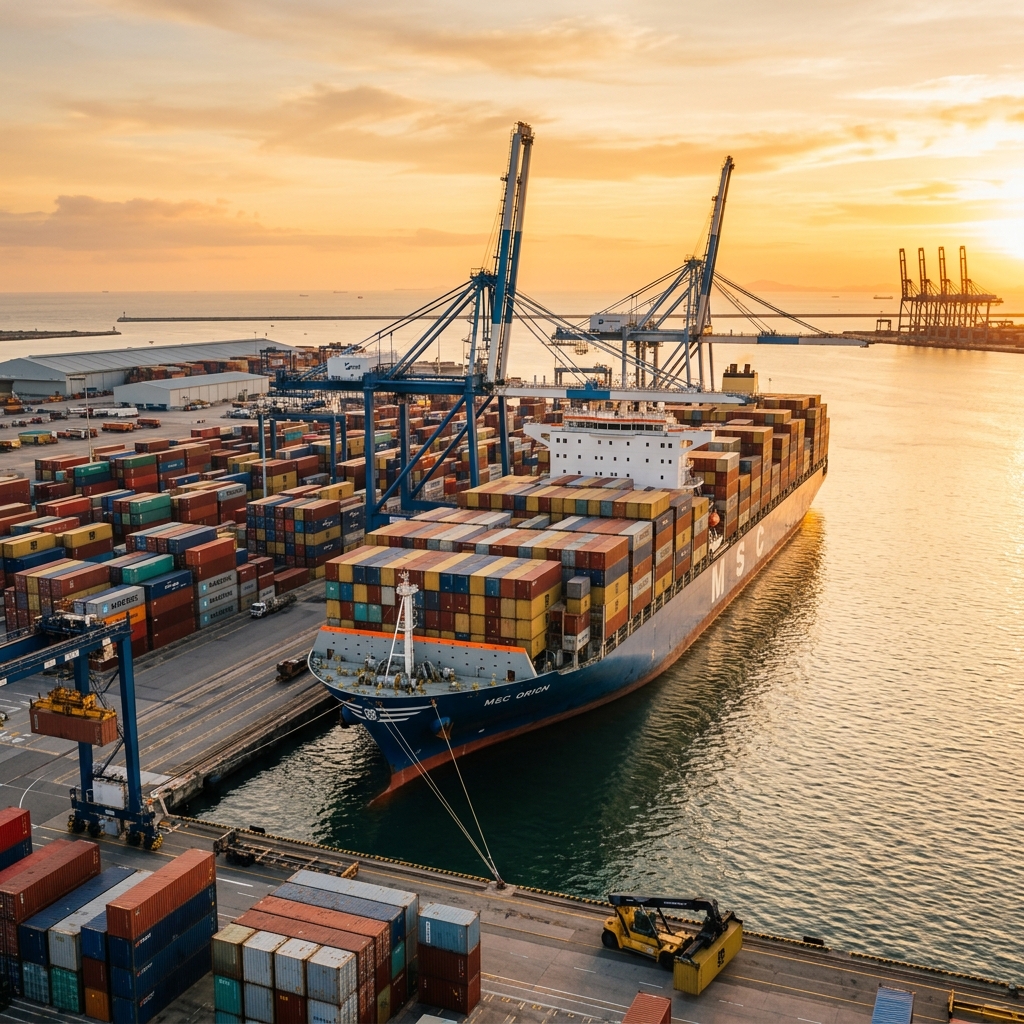
A restaurant group in Texas found bagasse plates at $0.08 per unit from a supplier in China. They calculated the total cost at $8,000 for 100,000 plates. When the shipping quote arrived, it added another $3,200 - a 40% increase they hadn't budgeted for.
The problem wasn't the shipping rate. It was not understanding how freight costs work for bulky, lightweight products like disposable tableware.
Understanding Total Landed Cost
Product price is just the starting point. According to the International Trade Administration, total landed cost includes the product price plus freight, customs duties, port fees, insurance, and inland transportation to your warehouse.
For a typical tableware order from China to the US, freight represents 20-35% of total cost. Customs duties add another 0-6.5% depending on product classification. Port fees and insurance typically add $500-1,000 per container. These additional costs can increase your total expenditure by 40-60% beyond the product price alone.
The key is calculating all costs upfront. Our Logistics Hub Calculator estimates complete landed costs based on your order details.
Weight Calculations: Why They Matter
Freight companies charge by weight or volume, whichever is greater. For tableware, volume usually determines the cost because products are bulky relative to their weight.
Actual Weight vs Volumetric Weight
Actual weight is straightforward - it's what the products weigh on a scale. Volumetric weight (also called dimensional weight) is calculated from package dimensions using the formula: Length × Width × Height in centimeters, divided by 5000.
Freight companies charge whichever is greater. If volumetric weight exceeds actual weight, you pay for volumetric weight. This affects tableware significantly because plates and cups are bulky relative to their weight.
Product Weight Reference
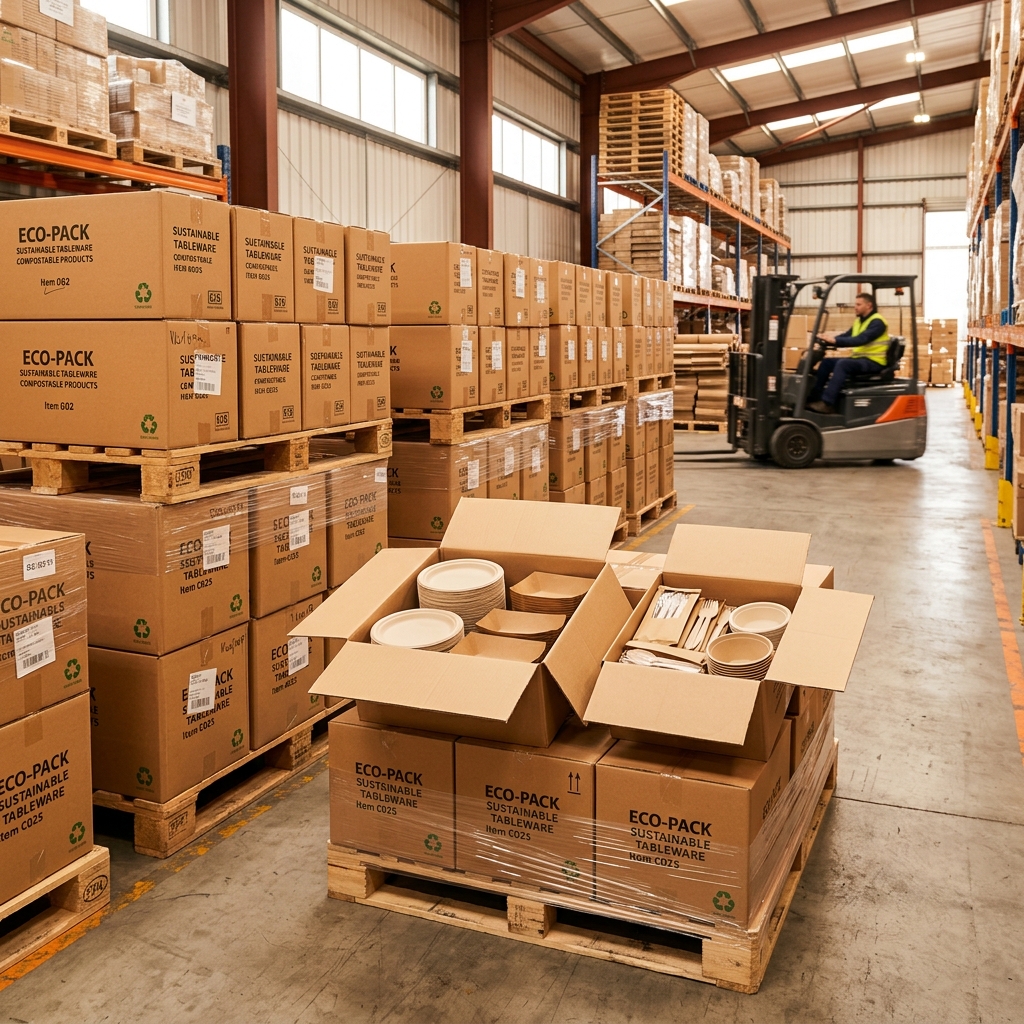
Based on industry data from major manufacturers:
Product Type | Size | Weight per 1000 pcs | Carton Size (cm) | Pcs per Carton |
|---|---|---|---|---|
Bagasse Plates | 9" | 20 kg | 48×48×35 | 500 |
Bagasse Plates | 10" | 26 kg | 52×52×38 | 400 |
Food Containers | 750ml | 17 kg | 55×40×45 | 300 |
Food Containers | 1000ml | 22 kg | 60×45×50 | 250 |
Coffee Cups | 12oz | 14 kg | 50×40×55 | 1000 |
Coffee Cups | 16oz | 18 kg | 55×45×60 | 800 |
Source: Manufacturer specifications, 2024
For example, a carton of 9" bagasse plates measuring 48×48×35 cm has a volumetric weight of 16.1 kg but an actual weight of 20 kg. You'd be charged for 20 kg since actual weight is higher. For bagasse plates wholesale orders, actual weight usually exceeds volumetric weight. For cups and lightweight containers, volumetric weight often applies, which can significantly increase shipping costs.
Shipping Methods Compared
Three main options exist for international tableware orders. Each has specific cost structures and use cases.
Sea Freight (Ocean Shipping)
Sea freight is the standard for bulk orders. According to Freightos Baltic Index data, rates from China to US West Coast averaged $2,800-4,500 per 40ft container in 2024.
Container Options:
Container Type | Capacity | Max Weight | Typical Cost* | Lead Time |
|---|---|---|---|---|
20ft Standard | 28 CBM | 22,000 kg | $2,000-3,500 | 25-35 days |
40ft Standard | 58 CBM | 26,000 kg | $3,500-5,500 | 25-35 days |
40ft High Cube | 68 CBM | 26,000 kg | $3,800-6,000 | 25-35 days |
*China to US West Coast, 2024 average rates
Sea freight works best for orders over 500 kg where delivery time isn't urgent. A 40ft container costing $4,500 can hold approximately 400,000 pieces of 9" plates, bringing the freight cost down to just $0.011 per plate.
Air Freight
Air freight costs $4-8 per kg depending on route and season. According to IATA Cargo data, rates peaked at $8-12/kg during 2020-2021 but stabilized to $4-6/kg by 2024.
Air freight makes sense for urgent orders under 500 kg, new product testing, or seasonal rushes. A 500 kg order of 25,000 plates costs approximately $2,500 in air freight at $5 per kg, bringing the per-plate cost to $0.10. Air freight costs 8-10 times more than sea freight per unit but delivers in 5-10 days instead of 30-35 days.
Express Courier (DHL, FedEx, UPS)
Express services charge $8-15 per kg with minimum charges around $50-100. Best for samples and very small orders.
Express services work best for sample orders under 50 kg or emergency replacements. A 50 kg sample order of 2,500 plates costs approximately $500 in express shipping at $10 per kg, bringing the per-plate cost to $0.20.
Calculate your shipping costs: Use our Logistics Hub Tool to compare all three methods for your specific order.
Cost Factors Beyond Freight
Customs Duties
US import duties for eco-friendly tableware are relatively low. According to the US Harmonized Tariff Schedule, bagasse plates typically fall under HTS 4823.69 with duties of 0-3.2%, paper cups under the same code with 0-4.5% duties, and food containers under HTS 3924.10 with 3.4-6.5% duties.
Proper classification matters. Work with a customs broker to ensure correct HTS codes. Misclassification can result in higher duties or shipment delays that cost more than the broker's fee.
Port Fees
US port fees vary by location. According to the Port of Los Angeles 2024 tariff schedule, container handling costs $200-400, customs clearance runs $150-300, documentation fees are $50-150, and inspections (if required) add $300-800. Total port fees typically range from $700 to $1,650 per container.
West Coast ports like Los Angeles, Long Beach, and Oakland are typically $200-400 cheaper than East Coast ports for shipments from Asia due to shorter transit times and higher container volumes.
Insurance
Cargo insurance costs 0.3-0.5% of insured value. Industry standard is to insure for 110% of product value to cover potential losses. For a $10,000 order, you'd insure $11,000 and pay $33-55 in insurance premiums.
Insurance is optional but recommended, especially for first-time importers or high-value orders. The small cost provides protection against damage, loss, or delays during transit.
Optimizing Mixed Orders
Combining different products in one shipment reduces per-unit costs. The key is maximizing container utilization.
Container Space Optimization
A 40ft container holds 58 CBM. According to logistics industry data, average container utilization is 75-85%, but proper planning can achieve 90-95%.
The first strategy is mixing heavy and light products. Containers have both weight limits (26,000 kg) and volume limits (58 CBM). Combine heavy items like bagasse plates with lighter items like coffee cups to use both limits efficiently.
The second strategy is filling empty spaces. Standard cartons leave gaps when stacked. Fill these with smaller items like coffee stirrers between plate cartons, napkins in empty corners, or smaller containers in gaps.
The third strategy is custom packaging. For large recurring orders, request custom carton sizes that stack more efficiently. This can improve utilization by 10-15% and reduce freight costs proportionally.
Our bagasse food containers and coffee cups are available with optimized packaging for mixed orders.
Seasonal Rate Variations
Freight rates fluctuate significantly by season. According to Freightos data, peak season runs from September through November when rates increase 40-60%, space becomes limited, and booking lead times extend to 4-6 weeks. This coincides with holiday inventory buildup.
Low season runs from February through April when rates drop 20-30%, more space is available, and booking happens faster in 1-2 weeks. The difference can mean thousands of dollars on a single container.
Planning tip: Order 3-6 months ahead for peak season needs. Lock in rates early to avoid surcharges and ensure space availability.
Using the Logistics Calculator
Our Logistics Hub Calculator handles complex calculations automatically:
Start by selecting your products (plates, containers, cups), entering quantities, and choosing your destination. The tool instantly calculates total weight (both actual and volumetric), recommends the best shipping method, estimates freight costs, provides a complete landed cost breakdown, and shows container utilization percentage.
You can also compare scenarios side-by-side: LCL versus FCL costs, sea freight versus air freight, and different product combinations to find the most cost-effective option for your needs.
Use our free Logistics Hub Calculator - no signup required.
Common Questions About Shipping Costs
How much does it cost to ship 10,000 plates?
Sea freight: $0.02-0.04 per plate. Air freight: $0.10-0.15 per plate. Use our Logistics Calculator for exact quotes.
What's cheaper: LCL or FCL?
LCL for orders under 25 CBM. FCL for orders over 30 CBM. Between 25-30 CBM, compare both options.
How long does sea freight take?
China to US West Coast: 25-35 days. China to US East Coast: 35-45 days. Add 1-2 weeks for customs and inland transport.
Can I combine plates, containers, and cups in one shipment?
Yes. Mixed orders are common and often more cost-effective. Our Logistics Hub calculates optimal combinations.
What are customs duties for bagasse plates?
0-3.2% for most bagasse plates. Exact rate depends on HTS classification. Work with a customs broker for accurate rates.
Is insurance necessary?
Recommended for orders over $5,000. Costs 0.3-0.5% of order value. Protects against damage, loss, or delays.