Every takeaway order leaves a carbon footprint you can't see. The food inside a container gets eaten in 20 minutes. The container itself? It sits in a landfill for 400 years, slowly releasing methane as it breaks down.
Here's what most restaurant owners don't realize: the packaging often has a bigger carbon footprint than the food inside. A plastic clamshell container generates 60 kg of CO2 per 1,000 units across its lifecycle. A beef burger generates about 50 kg of CO2 per kg of meat. Your packaging is literally competing with your food for environmental impact.
This creates an unexpected opportunity. You can't easily change your menu's carbon footprint - beef is beef, dairy is dairy. But you can change your packaging overnight. And unlike menu changes, customers actually notice and appreciate sustainable packaging.
Understanding Carbon Footprint in Food Packaging
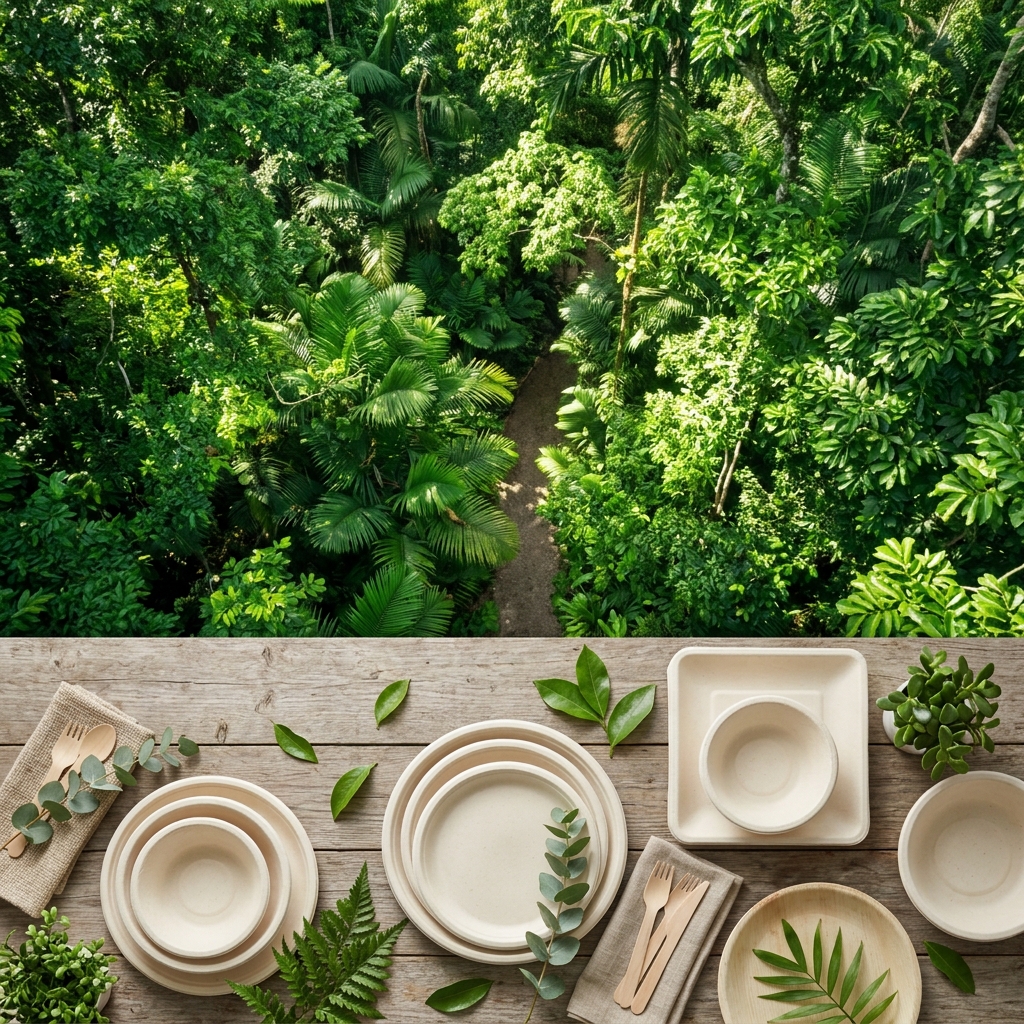
Carbon footprint measures total greenhouse gas emissions across a product's lifecycle, expressed as CO2 equivalent (CO2e). According to ISO 14040 standards for lifecycle assessment, this includes raw material extraction, manufacturing and processing, transportation, use phase, and end-of-life disposal.
For food containers, manufacturing and disposal create the most emissions. Transportation matters less than expected - it represents only 12-18% of total impact according to research from the University of Michigan Center for Sustainable Systems. The real difference comes from material sourcing and what happens after use.
Plastic Food Containers: The Full Carbon Cost
Plastic food containers start with petroleum extraction and refining. According to data from the American Chemistry Council, producing 1 kg of polypropylene (PP) plastic generates 1.9-2.3 kg of CO2e. For PET plastic commonly used in clamshells, the number is 2.1-2.5 kg CO2e per kg.
Plastic Container Lifecycle Emissions
Based on lifecycle assessment data from multiple peer-reviewed studies:
Lifecycle Stage | CO2e per 1000 containers (750ml) | Percentage |
|---|---|---|
Petroleum extraction | 18-22 kg | 32% |
Manufacturing | 25-32 kg | 48% |
Transportation | 6-9 kg | 13% |
End-of-life (landfill) | 4-6 kg | 7% |
TOTAL | 53-69 kg CO2e | 100% |
Sources: Environmental Science & Technology journal, 2023; Resources, Conservation & Recycling, 2024
The end-of-life impact is significant. Plastic containers in landfills take 400-500 years to break down. According to EPA data, they slowly release methane (a greenhouse gas 25 times more potent than CO2) as they degrade. Most plastic food containers are contaminated with food residue, making them non-recyclable despite the recycling symbol on the bottom.
Styrofoam containers are worse. They generate 58-75 kg CO2e per 1,000 containers and never fully biodegrade. Many cities have banned them, but they're still common in food service.
Bagasse Food Containers: A Different Calculation
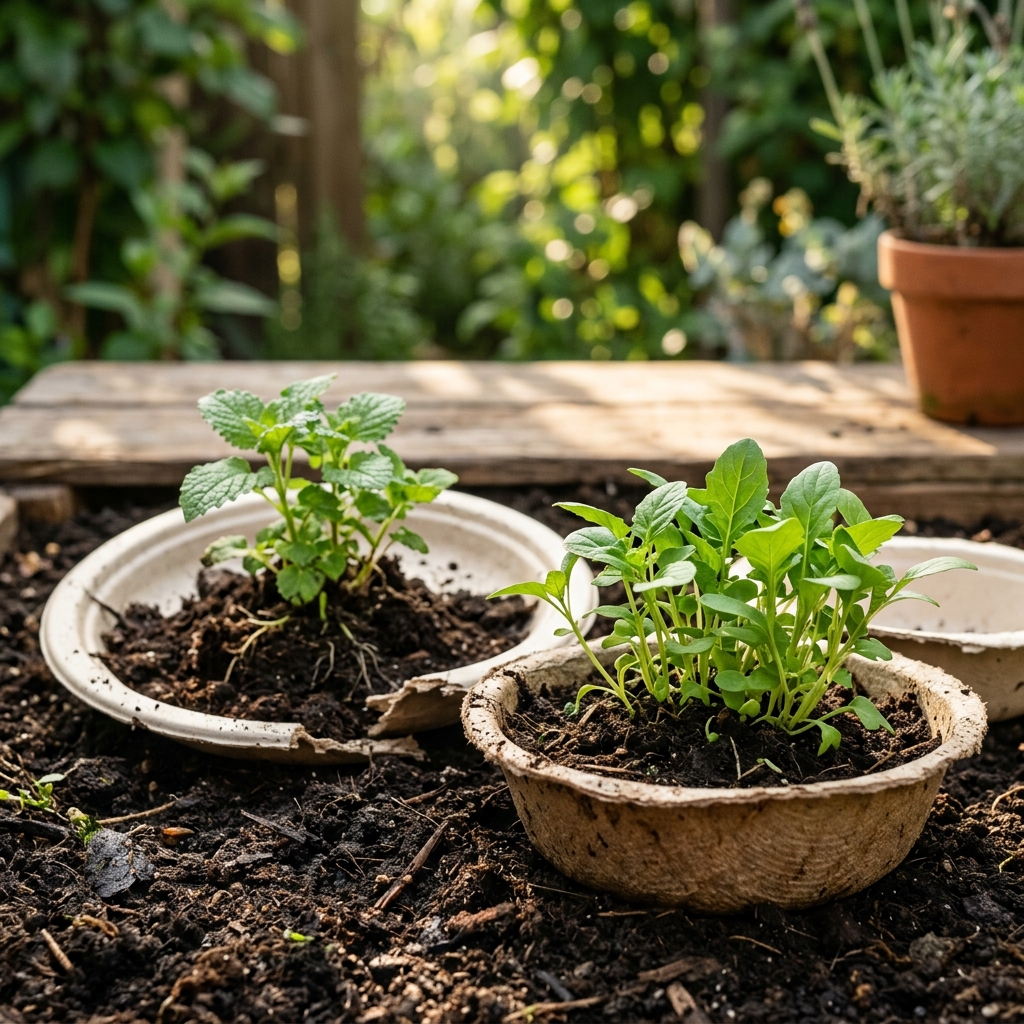
Bagasse is the fibrous residue left after extracting juice from sugarcane. Instead of being burned or discarded, it's processed into food containers. This changes the carbon equation significantly.
Bagasse Container Lifecycle Emissions
Lifecycle Stage | CO2e per 1000 containers (750ml) | Percentage |
|---|---|---|
Raw material (waste byproduct) | 3-4 kg | 18% |
Manufacturing | 8-12 kg | 56% |
Transportation | 3-4 kg | 18% |
End-of-life (composting) | 1-2 kg | 8% |
TOTAL | 15-22 kg CO2e | 100% |
Sources: Journal of Cleaner Production, 2024; International Journal of Life Cycle Assessment, 2023
Bagasse manufacturing uses 65% less energy than plastic production. According to research from the Technical Association of the Pulp and Paper Industry (TAPPI), bagasse pulping requires 45-55% less energy than virgin paper production and 75% less than plastic manufacturing.
Our bagasse food containers are manufactured using this lower-energy process and are certified compostable per ASTM D6400 standards. They're FDA approved for food contact and handle temperatures up to 200°F, making them suitable for hot foods, soups, and microwave reheating.
Why Bagasse Containers Have Lower Impact
Bagasse offers four key environmental advantages. First, it utilizes agricultural waste - sugarcane is grown for sugar production, and bagasse is a byproduct that would otherwise be burned (releasing CO2) or landfilled. Using it for containers doesn't require additional agricultural land or resources.
Second, sugarcane absorbs CO2 as it grows. While this carbon is released when bagasse decomposes, the net impact is lower than petroleum-based products that add new carbon to the atmosphere. This creates a more circular carbon cycle.
Third, bagasse pulping occurs at 160-180°C while plastic manufacturing requires 200-300°C. According to industrial energy data, this represents a 45-65% energy reduction in the manufacturing process. Lower temperatures mean less fuel consumption and fewer emissions.
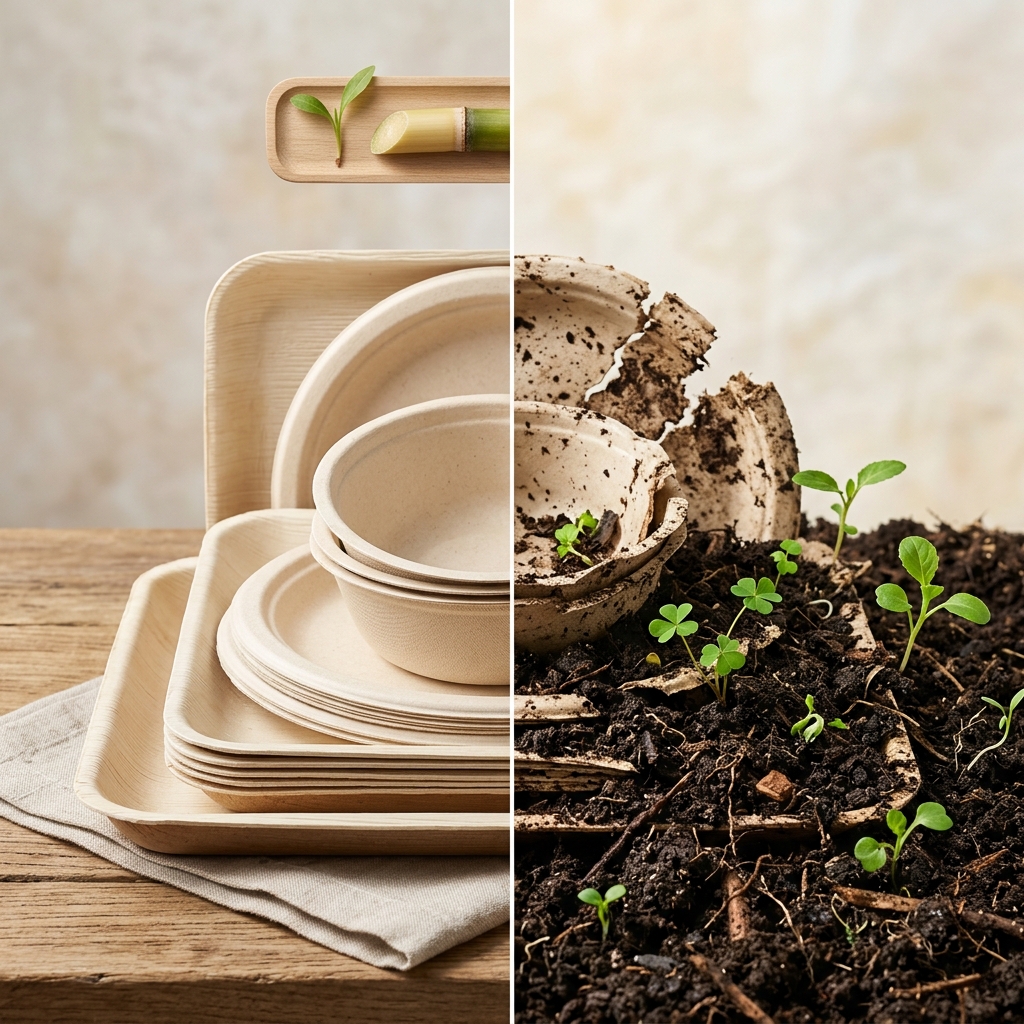
Fourth, bagasse containers compost in 60-90 days per BPI certification standards. They return nutrients to soil instead of sitting in landfills for centuries. Even in landfills where composting isn't available, they degrade in 3-5 years compared to 400-500 years for plastic.
Carbon Savings by Restaurant Size
Here are actual calculations based on verified emission factors. All numbers use conservative estimates from peer-reviewed sources.
Small Café or Food Truck (200 containers/day)
A small operation using 200 plastic containers daily generates 73,000 containers annually. At 60 kg CO2e per 1,000 containers, this produces 4,380 kg or 4.4 tons of CO2 each year.
After switching to bagasse containers with the same usage, emissions drop to 18 kg CO2e per 1,000 containers, producing only 1,314 kg or 1.3 tons of CO2 annually.
The annual carbon savings of 3.1 tons CO2 is equivalent to driving 7,700 miles in an average car (EPA: 404g CO2/mile), planting 140 tree seedlings (EPA: 21.8 kg CO2/tree/year), or using 3,600 kWh of electricity (EPA: 0.85 kg CO2/kWh).
Source: EPA Greenhouse Gas Equivalencies Calculator, 2024
Mid-Size Restaurant (500 containers/day)
A mid-size restaurant using 500 plastic containers daily generates 182,500 containers annually, producing 10,950 kg or 11 tons of CO2. After switching to bagasse containers, annual emissions drop to 3,285 kg or 3.3 tons.
The annual carbon savings of 7.7 tons CO2 is equivalent to taking 1.7 cars off the road for a year (EPA: 4.6 tons CO2/car/year), planting 350 tree seedlings, or powering 1.1 homes for a year (EPA: 7.1 tons CO2/home/year).
Large Restaurant or Chain (1,000 containers/day)
A large operation using 1,000 plastic containers daily generates 365,000 containers annually, producing 21,900 kg or 21.9 tons of CO2. After switching to bagasse containers, annual emissions drop to 6,570 kg or 6.6 tons.
The annual carbon savings of 15.3 tons CO2 is equivalent to taking 3.3 cars off the road for a year, planting 700 tree seedlings, or 9 round-trip flights from New York to London (EPA: 1.6 tons CO2/passenger).
Calculate your restaurant's savings: Use our Sustainability Calculator to input your actual container usage and get customized results.
Cost vs Environmental Benefit
The carbon savings come with a cost difference. Here's the realistic financial picture for 750ml containers.
Price Comparison (750ml containers, bulk orders)
Container Type | Cost per Unit | Annual Cost (500/day) |
|---|---|---|
Plastic | $0.12 | $21,900 |
Bagasse | $0.18 | $32,850 |
Difference | +$0.06 | +$10,950 |
Source: Industry pricing data, 2024
Cost per ton of CO2 saved: $10,950 ÷ 7.7 tons = $1,422/ton
For context, carbon offset programs typically charge $15-30 per ton. At $1,422/ton, switching to bagasse food containers is more expensive than buying offsets, but it provides tangible environmental action that customers can see and appreciate. The containers are also microwave-safe and leak-resistant, offering functional benefits beyond sustainability.
The Business Case Beyond Carbon
According to a 2024 study by the National Restaurant Association, 78% of consumers consider sustainability when choosing takeaway restaurants. Of those consumers, 52% are willing to pay 5-10% more for sustainable packaging, 68% view compostable containers positively, and 41% actively seek out restaurants with environmental commitments.
The $10,950 annual cost increase for a mid-size restaurant represents less than 0.7% of typical annual revenue ($1.5-2 million). For many restaurants, the marketing value and customer loyalty exceed this cost. Several restaurants report that highlighting compostable packaging on delivery apps increased order volume by 8-15%.
Measuring and Reporting Your Impact
Quantifying environmental impact helps with ESG reporting, marketing, and certifications like Green Restaurant Certification or B Corp status.
Key Metrics to Track
Track three key metrics to quantify your environmental impact. First, calculate total CO2 avoided per year using the formula: (Plastic emissions minus Bagasse emissions) multiplied by annual container usage, divided by 1,000.
Second, measure plastic waste diverted in kilograms per year. An average 750ml plastic container weighs 18-22g, while bagasse containers weigh 28-32g but are compostable. Calculate plastic diverted by multiplying container count by 0.020 kg.
Third, convert CO2 savings to equivalent metrics that people understand: cars off the road, trees planted, or homes powered. Use EPA's Greenhouse Gas Equivalencies Calculator for accurate conversions.
Creating Your Sustainability Report
Our Sustainability Calculator generates professional reports including annual CO2 savings calculations, equivalent impact metrics, month-by-month tracking, downloadable PDFs for stakeholders, and social media graphics. The tool uses verified emission factors from EPA and peer-reviewed research.
Many restaurants display their annual carbon savings on receipts, menu boards, or delivery packaging. This transparency builds customer trust and differentiates your brand in competitive markets.
Beyond Containers: Complete Packaging Impact
Switching all disposable packaging multiplies your impact.
Combined Carbon Savings
For a restaurant using 500 units daily of each:
Product | Plastic CO2 | Bagasse/Compostable CO2 | Annual Savings |
|---|---|---|---|
Food Containers | 11.0 tons | 3.3 tons | 7.7 tons |
Plates | 9.1 tons | 2.7 tons | 6.4 tons |
Cups | 7.1 tons | 2.9 tons | 4.2 tons |
TOTAL | 27.2 tons | 8.9 tons | 18.3 tons |
Emission factors from Journal of Cleaner Production, 2024
Complete packaging switch saves 18.3 tons CO2 annually - equivalent to taking 4 cars off the road.
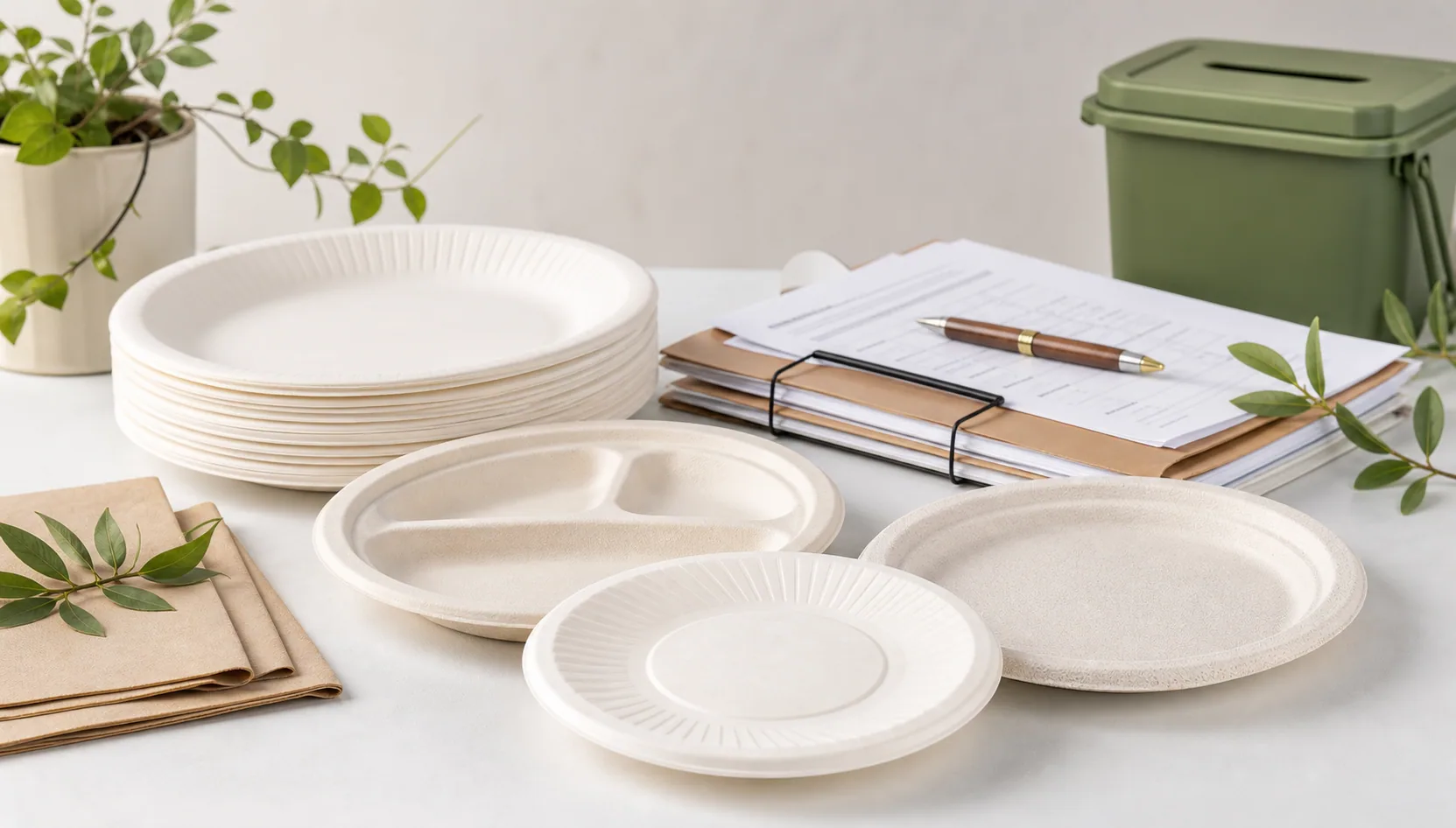
Our bagasse food containers work alongside compostable plates and eco-friendly cups for a complete sustainable solution.
Container Performance and Specifications
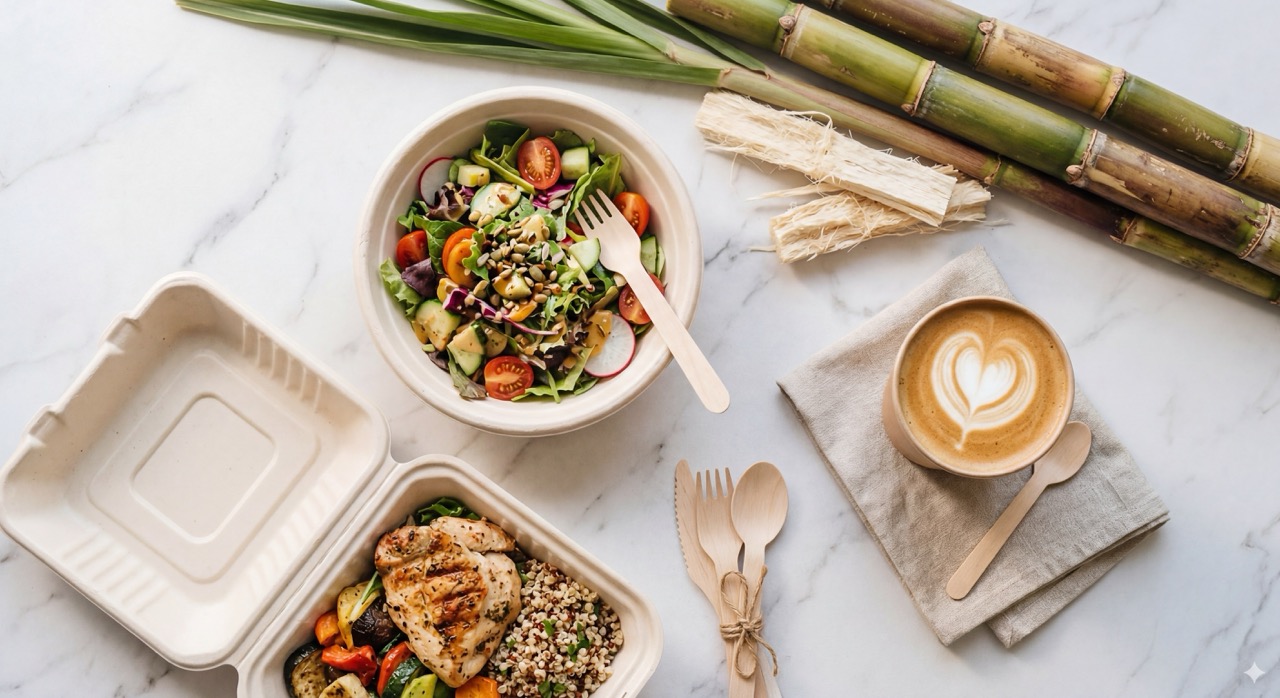
Environmental benefits matter, but containers must also perform. Our bagasse food containers meet professional food service requirements.
Technical Specifications
Bagasse containers handle hot foods up to 200°F, making them suitable for soups, curries, pasta, and other hot entrées. They're microwave-safe for reheating, which plastic containers often aren't. The material is naturally grease and moisture resistant without requiring plastic or wax coatings.
Containers are available in multiple sizes: 450ml (16oz) for sides and desserts, 750ml (24oz) for standard entrées, 1000ml (32oz) for large portions, and compartment styles for combination meals. All sizes are FDA approved for food contact and certified compostable per ASTM D6400 standards.
The containers stack efficiently for storage, taking up similar space to plastic alternatives. They're compatible with standard lids (sold separately) for secure transport and delivery.
Verification and Certifications
Environmental claims require verification. Here's what to look for.
Third-Party Certifications
BPI Certification from the Biodegradable Products Institute verifies products meet ASTM D6400 or D6868 standards for compostability. Products must break down in 180 days in commercial composting facilities. Our containers carry BPI certification, ensuring they'll compost as claimed.
Carbon Trust Certification provides verified carbon footprint data based on ISO 14040 lifecycle assessment standards, giving you credible numbers for reporting.
FDA Food Contact Approval ensures products are safe for food contact. All our bagasse food containers carry FDA approval for safe use with all food types, including hot, cold, wet, and oily foods.
FSC Certification (Forest Stewardship Council) verifies sustainable sourcing practices. While bagasse isn't wood, FSC principles apply to agricultural fiber sourcing, ensuring responsible supply chains.
Ready to calculate your carbon savings?
Use our free Sustainability Calculator - no signup required.
Common Questions About Carbon Impact
Are bagasse containers really better if they're heavier to ship?
Yes. Transportation adds 3-4 kg CO2 per 1,000 containers. Manufacturing and disposal differences save 35-45 kg CO2 per 1,000 containers. Net savings: 32-42 kg CO2 per 1,000 containers (65-75% reduction).
What if my city doesn't have composting?
Even in landfills, bagasse degrades in 3-5 years versus 400-500 years for plastic and produces less methane. The manufacturing emissions savings alone (17-20 kg CO2 per 1,000 containers) make bagasse better than plastic.
Can customers microwave these containers?
Yes. Our bagasse containers are microwave-safe up to 200°F. Plastic containers often melt or leach chemicals when microwaved, especially with hot or oily foods.
How do I prove these savings to customers?
Use our Sustainability Calculator to generate verified reports. Display BPI certification and carbon savings on receipts, menu boards, or delivery packaging.
Can I include this in ESG reporting?
Yes. The calculations use ISO 14040 standards accepted for ESG reporting. Include supplier certifications (BPI, FDA, FSC) and monthly purchase records as documentation.
Do bagasse containers work for liquids and soups?
Yes. Bagasse is naturally moisture-resistant and handles liquids well. Our containers are tested for soup, curry, and other liquid foods without leaking or softening.