

Understanding the Core Concepts
Compostability describes a product breaking down under specific composting conditions—usually commercial or industrial facilities—within a defined timeframe and without harmful residue. In contrast, biodegradability is broader: it means the material can degrade biologically, but the speed, environment, and completeness depend on the specific product and conditions. When evaluating are pha straws compostable, it's important to recognize that while the PHA polymer family has inherent biodegradation properties, calling a finished straw "compostable" requires product-level testing, not just a material data sheet. Similarly, answering do pha straws biodegrade requires context about the specific disposal environment.
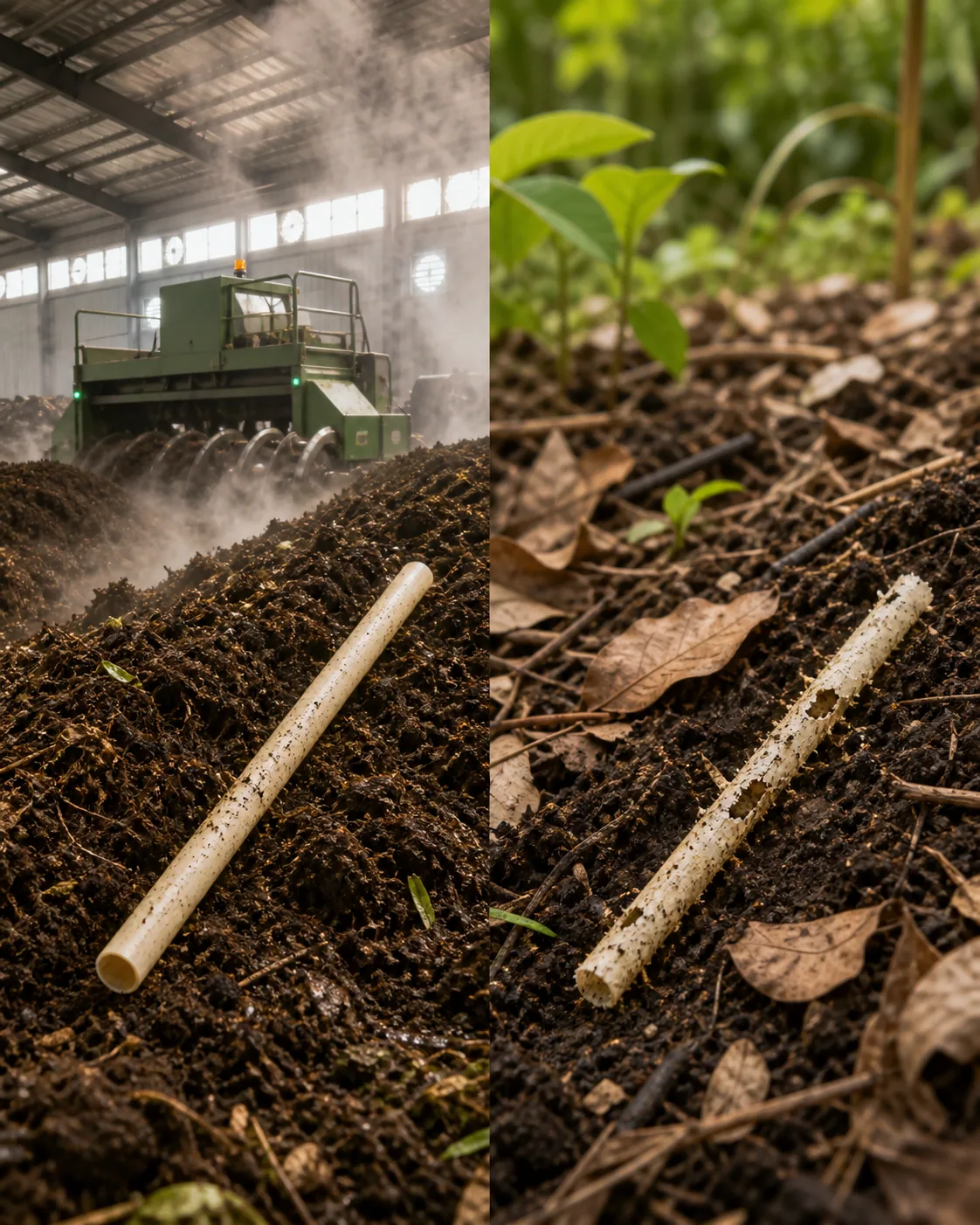 For straws, this distinction matters because the product is small, light, and often mixed with cups, lids, and food residue after service. A finished PHA straw may support one environmental statement, while the printed wrapper, inner bag, and master carton might require different wording. Maintaining clear pha straw composting claims involves keeping these items separate in the order record: straw material, wrapper material, claim wording, carton mark, and destination market. While it sounds like paperwork, this separation ensures that environmental claims are backed by solid evidence rather than just copied across all packaging surfaces.
The Reality of PHA and Composting
While PHA has a better biodegradation profile than most petroleum-based plastics, a finished straw is different from a raw resin pellet. The final product includes additives, colorants, potential blends with bamboo powder or sugarcane fiber, and the wrapper itself. All of these components affect how the straw performs in a composting environment.
Drafting wrapper copy that says "100% compostable" based solely on the PHA material name can create downstream problems—especially in the U.S. and EU, where regulators and retailers closely scrutinize environmental language. As the EPA notes, compostable plastics are generally designed for commercial or industrial composting conditions, not standard backyard bins. Additionally, BPI's compostability certification program serves as a common reference for commercial compostability claims in North America. Ultimately, any claim wording should closely align with the available evidence rather than just the material name.
A thorough order file typically specifies the exact disposal wording that will appear on the product page, wrapper, and carton. If the environmental claim is still under review, focusing the straw's description on its material and application first, and adding the environmental wording only after the claim file is confirmed, helps maintain accuracy and compliance.
What to Print on Your Wrapper
Buyers sometimes use "biodegradable," "compostable," and "bio-based" interchangeably on early drafts. They mean very different things, and mixing them up can stall a wrapper approval or create liability.
| Claim on Your Wrapper | What It Tells the End User | What You Need Before Printing |
|---|---|---|
| Bio-based PHA straw | Made from biological feedstock | Material spec sheet with bio-based content detail |
| Commercially compostable | Breaks down in a commercial composting facility | Finished-product test data referencing ASTM D6400 or EN 13432, or BPI certification |
| Biodegradable | Breaks down biologically under stated conditions | Product-specific test data with environment and timeframe stated |
| Marine biodegradable | Breaks down in ocean or marine environments | Dedicated marine biodegradation test — cannot be assumed from land-based data |
| Plastic-free | Contains no conventional plastic | Technical and legal review for the specific market definition |
When we prepare claim files for PHA orders, we typically include the SKU name, material blend, straw dimensions, test or certificate references, proposed wrapper language, and the destination market. That way the claim file and the commercial documents stay linked.
Why the Finished Product Matters
Evaluating the finished product is crucial because different variations of PHA behave differently. For instance, a PHA Bamboo Powder Straw and a PHA Sugarcane Bagasse Straw share a PHA base, but their blend ratios, filler types, and production processes vary. Therefore, test data for one does not automatically apply to the other.
Consider a scenario where a hotel group wants to include "compostable" on wrapped straws for room-service trays across three different PHA SKUs: a 6mm straight straw, an 8mm straight straw, and a 12mm boba straw. If the available test data only covers the 6mm product, printing qualified language—such as "commercially compostable, tested per ASTM D6400"—on the 6mm SKU while using "bio-based PHA" on the others until testing is complete ensures compliance and transparency. This approach aligns perfectly with the expectations outlined in the FTC's Green Guides, which emphasize that claims should be specific, qualified, and backed by evidence for the exact product being sold.
Copying claim wording directly from one SKU to another or from a competitor's listing can create inconsistencies between the wrapper, the product page, and the necessary documentation for retailers or auditors. Settling on the exact wrapper text before the artwork starts helps avoid the costly process of changing printed wrappers after production has already begun.
How We Help with Claim Documents
We don't write the legal claim for you, but we do build the supporting file. For each PHA straw order, we can provide:
- Product specification (material blend, dimensions, color, packing format)
- Available test or certification references for the finished SKU
- Wrapper proof review — we check proposed environmental language against what the test data actually supports
- Carton marking guidance for the destination market
This applies across the PHA range: PHA White Straw, PHA Coffee Grounds Straw, or any custom blend. The point is to keep the claim file tied to the real product — not to a generic material story.
Moving Forward with Confidence
Navigating environmental claims requires precision. A common misconception is that "biodegradable" is somehow a safer or easier label to use than "compostable." In reality, an unqualified "biodegradable" claim can draw significant regulatory scrutiny because it is inherently vague without specific context regarding conditions and timeframes. Similarly, you cannot simply call every PHA straw "compostable"; the claim strictly requires finished-product evidence for that exact SKU.
This is where the most common mistakes happen—like applying one SKU's test data across an entire product range. Different straw sizes, material blends, and fillers all necessitate their own specific review. While you can certainly print compostable language on a custom wrapper, the wording must first be meticulously confirmed against the product's test data and your destination market's specific requirements. At TOGO, we treat this strict verification process as a core part of sourcing our PHA Straws Wholesale. We review proposed wrapper text during the proofing stage to ensure nothing gets printed that the evidence doesn't fully support. It is a quick check during the quoting phase, but it prevents costly errors after thousands of wrappers are printed.
When you are ready to evaluate these options for your brand, simply share your target claim wording, destination market, preferred straw sizes, packing format, and forecast volume with us. We will provide the right samples, the precise spec sheet, and the necessary claim documentation, ensuring your project is built on solid evidence from the very start.