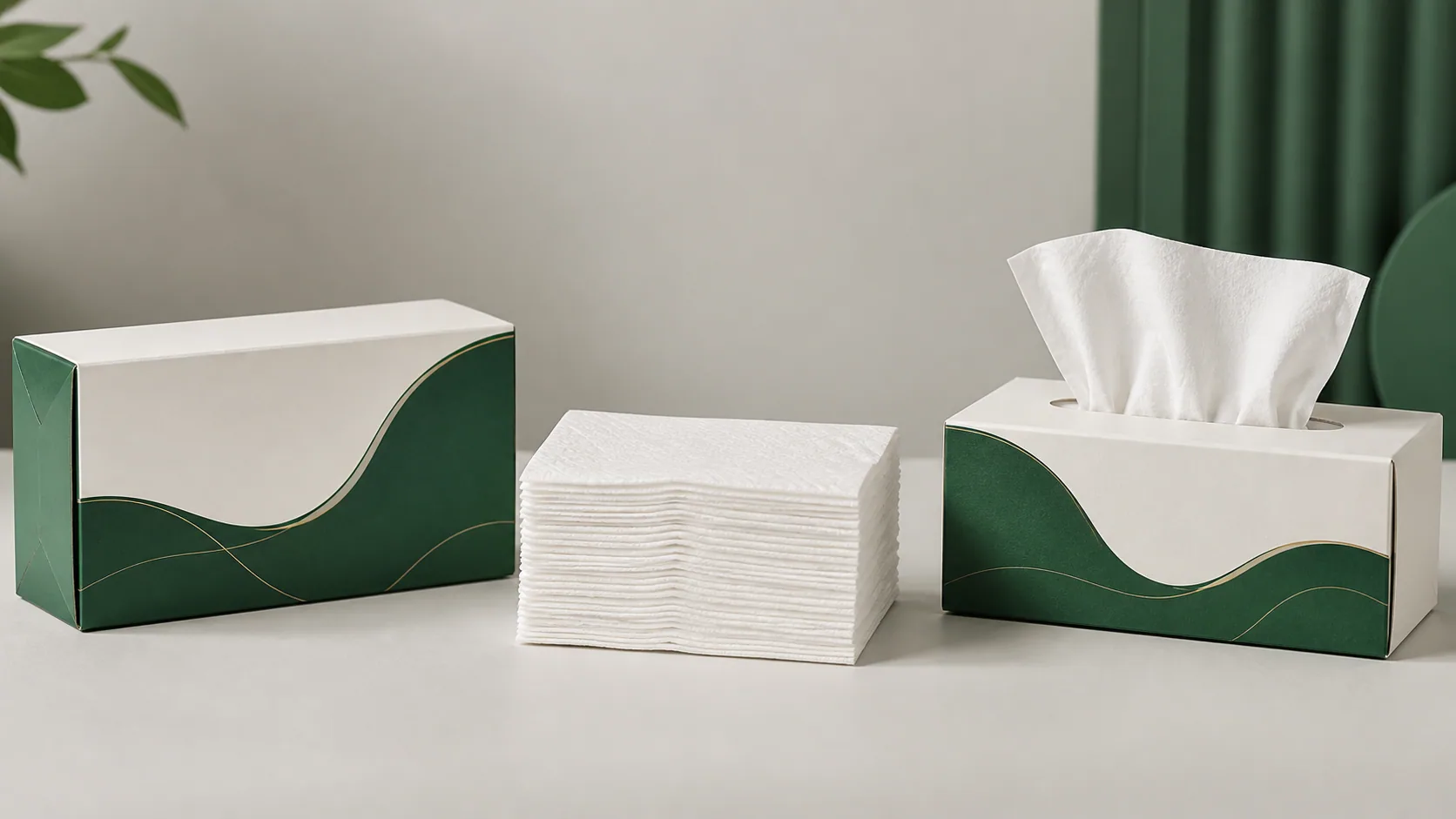
Most custom packaging print shops only sell flat, empty paperboard boxes—they do not make or load facial tissue inside. If you need retail-ready boxes for hotels, restaurants, car dealerships, or e-commerce bundles, ordering tissue-filled finished packs from an integrated converter saves manual stuffing labor, avoids hygiene issues, and prevents torn first pulls.
You do not need finished artwork or a dieline to compare costs. Share your preferred box shape and paper ply first, and TOGO will match the carton depth to the folded stack, prepare a 5–7 day filled sample, and quote our custom box facial tissue as one ready-to-use wholesale pack.
Filled Finished Boxes vs. Empty Printed Cartons at a Glance
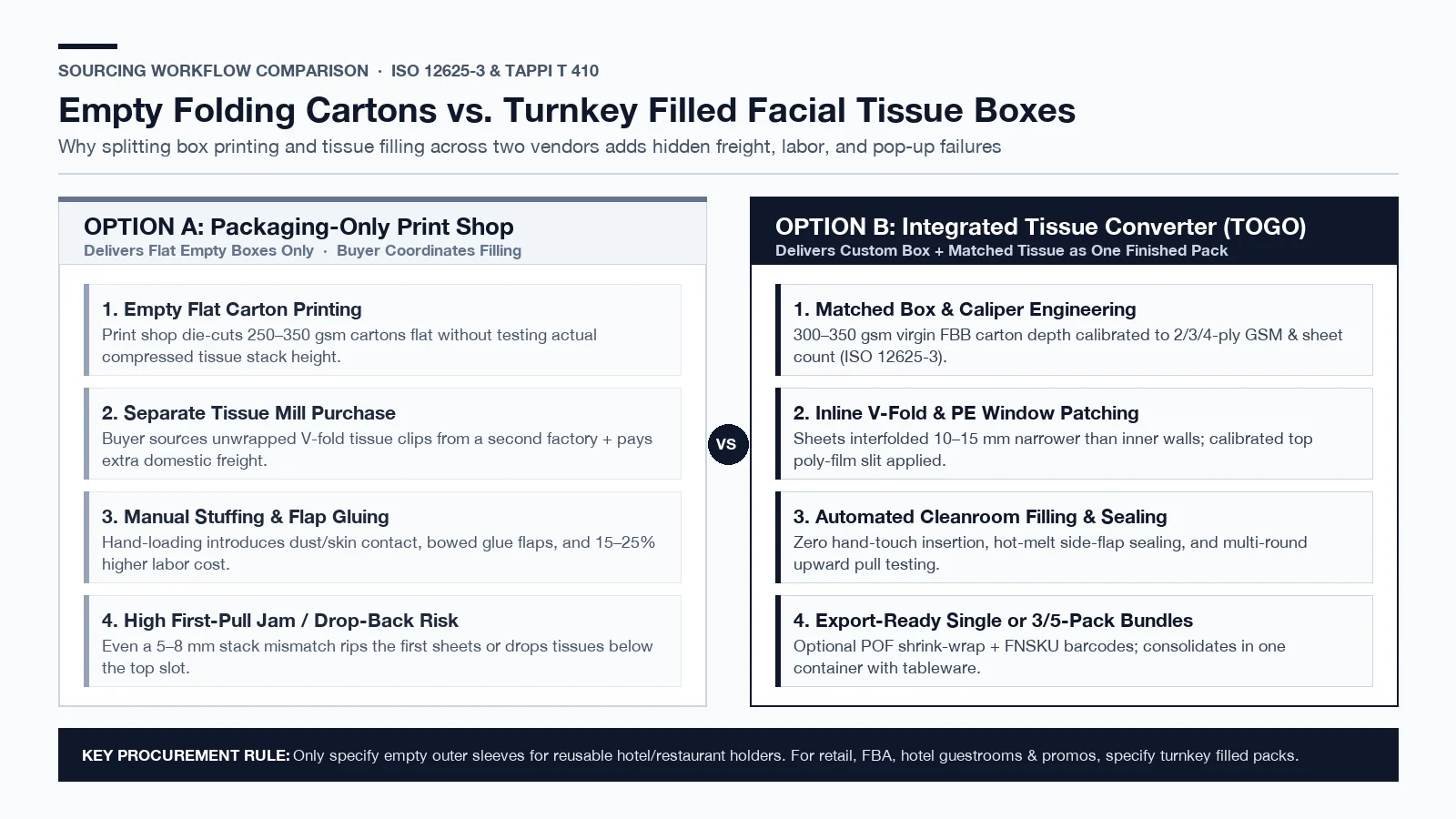
At first glance, a print-shop quote of a few cents per flat carton looks cheap. Once you add bulk tissue refills from a second mill, extra domestic freight between factories, and warehouse hand-packing, split sourcing almost always costs more per finished box.
Compare both sourcing routes across real production and delivery checkpoints:
| Sourcing Checkpoint | Packaging-Only Print Shop (Empty Boxes) | Integrated Tissue Converter (Filled Packs) |
|---|---|---|
| What arrives at your door | Flat, unfolded paperboard blanks with no tissue inside | Printed, glued cartons machine-filled with tissue and sealed |
| Dispensing & stack fit | Box height is guessed without testing actual paper bulk | Carton depth is matched to ply, GSM, and V-fold height |
| Hygiene & dust control | High risk during manual unpacking, stuffing, and re-gluing | Enclosed automated interfolding, insertion, and hot-melt sealing |
| Supply-chain steps | 2+ vendors, 2 domestic freight legs, plus assembly labor | 1 supplier, 1 QC sample approval, direct export loading |
| Amazon & retail readiness | Buyer must assemble, fill, shrink-wrap, and label locally | Optional 1-box or 3/5-pack shrink-wrap with FNSKU barcodes |
| Best commercial use | Reusable outer vanity covers slipped over sealed soft-packs | Hotels, restaurants, retail shelves, FBA, car canisters, gifts |
Why Buying Empty Boxes and Stuffing Tissue Separately Backfires
Stack Height Mismatch Tears the First Sheets
Commercial facial tissue thickness varies widely depending on basis weight (measured under ISO 12625-6, typically 13.5 to 16 gsm per ply) and paper bulk (measured under ISO 12625-3). A 100-sheet stack of 3-ply virgin pulp or moisturizing lotion tissue sits much taller than a 100-sheet stack of thin 2-ply paper.
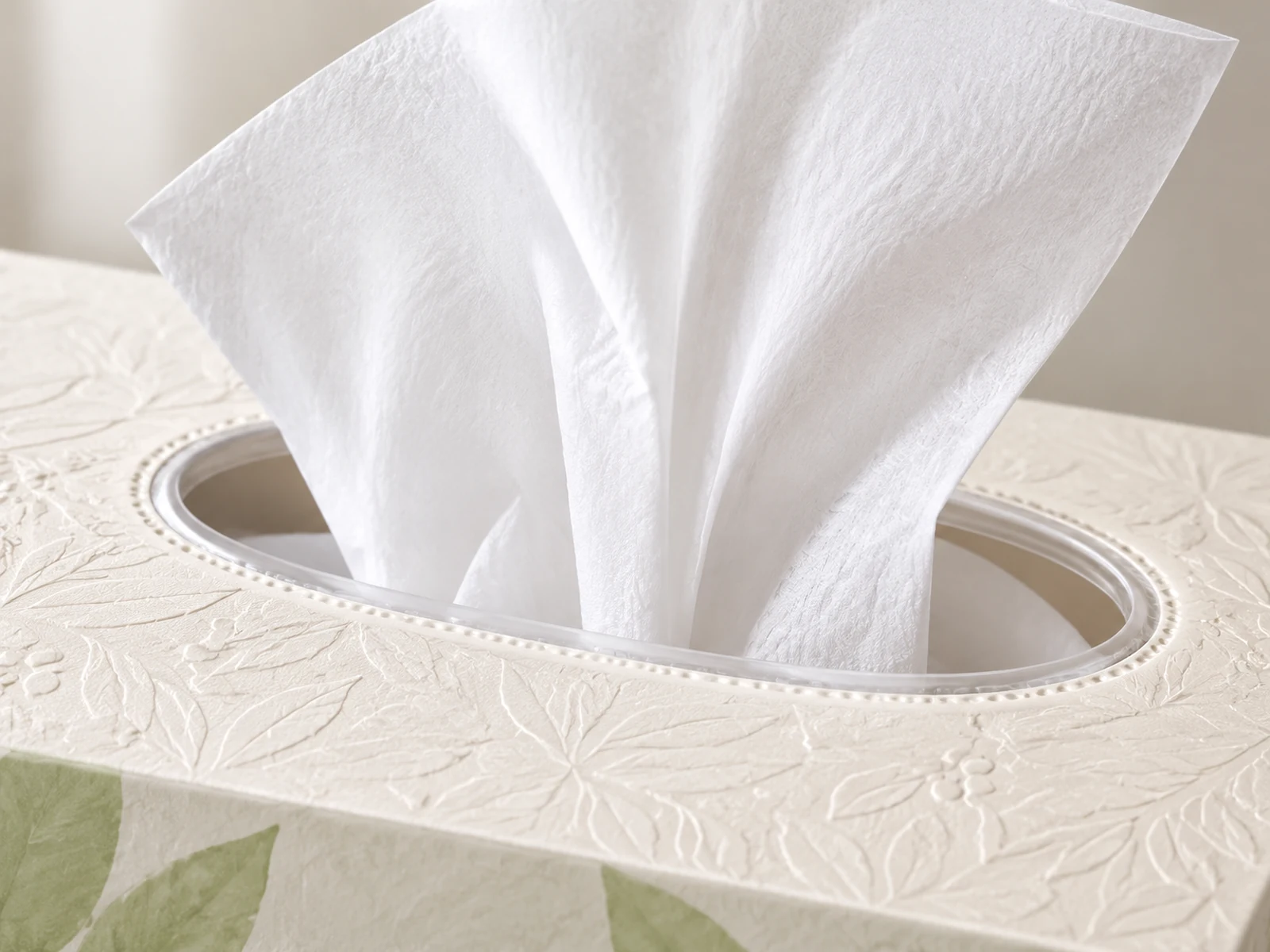
When a print shop cuts an empty carton without testing your actual tissue clip, even a 5 to 8 mm (0.2 to 0.3 in) height error ruins dispensing. A shallow box squeezes the stack against the top cutout so the first four sheets rip, while an oversized box lets remaining tissues slump back inside—see our custom tissue box sizes and ply guide for exact dimension pairings.
Hand-Loading Hygiene Risks and Extra Freight Legs
Unwrapped facial tissue clips absorb warehouse dust, ambient humidity, and hand oils the moment workers open master bags to stuff empty cartons by hand. For hotel guestrooms, dental clinics, skincare brands, and dining tables, hand-stuffed tissue creates an avoidable hygiene complaint.
Splitting your order across two factories also introduces four hidden expenses:
- Double domestic trucking: Bulky tissue cartons must travel from a paper converter to a separate print or co-packing facility before export.
- Slower assembly labor: Folding bottom flaps, inserting loose V-fold stacks without wrinkling edge sheets, and taping or gluing ends by hand adds 15% to 25% to unit cost.
- Popped side flaps: Hand-applied tape or cold glue often loosens inside warm, humid ocean containers.
- Split quality accountability: If tissues jam at the slot, the box printer blames the paper mill and the paper mill blames the box die-cut.
How Integrated Factories Build One Ready-to-Use Pack
In an integrated private-label run, box printing and tissue converting follow one shared specification sheet (guided by general tissue quality terminology under ISO 12625-1). Outer cartons are printed on 300 to 350 gsm (14 pt to 18 pt) virgin coated white Folding Boxboard (tested per TAPPI T 410) or unbleached kraft board so walls stay crisp in humid bathrooms and transit cartons.
Once print sheets are laminated and die-cut, four automated steps happen under one roof:
- Window film patching: Clear polyethylene (PE) film is glued inside the top oval opening with a precision slit that grips each rising tissue without snagging.
- Matched V-fold slitting: Parent tissue reels are embossed, interfolded, and trimmed 10–15 mm (0.4–0.6 in) narrower than the inner carton length so sheets lift freely past glued end flaps.
- Inline cartoning & hot-melt sealing: Automated pushers slide each counted stack straight into the printed carton and seal both side flaps with clean hot-melt adhesive.
- Multi-pack overwrapping: Finished boxes go straight into export cartons or tight 3-pack and 5-pack POF shrink-wrap bundles for moisture and crush protection.
When Empty Outer Covers Work—and When Turnkey Packs Win
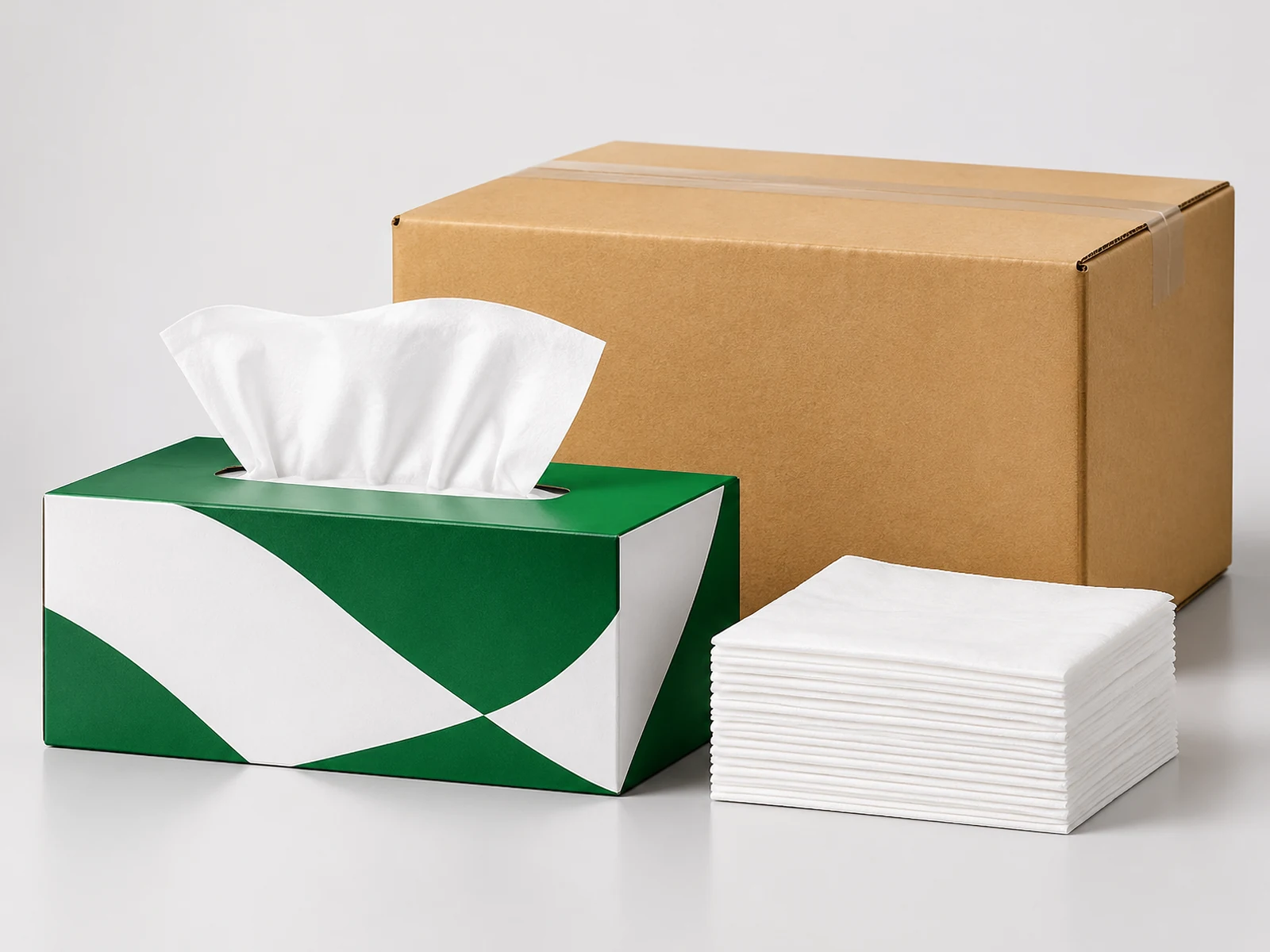
Buying an empty outer box only makes commercial sense when you use reusable outer cover sleeves—such as rigid vanity covers or heavy kraft table holders placed over sealed plastic soft-pack refills. In busy casual restaurants, staff can wipe down the outer sleeve and swap inner soft-packs in seconds.
For standard hotel amenities, corporate promotions, car cup-holder canisters, supermarkets, and Amazon FBA bundles, turnkey filled boxes deliver cleaner presentation and lower total landed cost. Buyers can also request paperboard and pulp aligned with FSC Chain-of-Custody (FSC-STD-40-004), and load tissue cartons into the same sea container as TOGO disposable wooden cutlery and custom non-woven bags to save on ocean freight.
Frequently Asked Questions
How can I tell if a supplier sells filled tissue boxes or empty cartons?
Check whether their quote specifies tissue ply count, basis weight (13.5–16 gsm/ply), unfolded sheet dimensions, and sheets per box alongside carton board weight. If a quote only lists cardboard thickness and CMYK printing with a 100-piece MOQ, they are quoting empty flat boxes without tissue.
Is the MOQ higher for filled custom tissue boxes than empty cartons?
Integrated filling lines need a setup run to calibrate paper folding and cartoning, so MOQs are higher than digital empty-box shops—but TOGO keeps MOQ flexible by box style. Confirm your preferred box shape and paper spec first, and we will quote practical trial or bulk tiers.
Can I get pricing for filled tissue boxes before my dieline is ready?
Yes. Tell us where the boxes will be used (hotel room, restaurant table, car cup holder, or retail 3/5-pack) and the tissue feel you want. TOGO confirms the exact box dimensions and stack spec first, then sends your quote with a matching blank dieline.
Do filled facial tissue boxes ship flat or fully assembled?
Filled tissue boxes ship fully assembled, sealed, and packed inside master export cartons so they are ready to place on shelves or tables upon arrival. Because assembled tissue boxes are lightweight, restaurant and hotel buyers often mix them in one container with heavier tableware to maximize container space.
How long does a printed, tissue-filled sample take?
TOGO produces custom printed boxes filled with your chosen 2-ply, 3-ply, 4-ply, or lotion tissue in 5–7 days, letting you verify print colors, hand softness, and upward pop-up pull before bulk manufacturing.
Sources & Industry Test Standards
- ISO 12625-1: Tissue paper and tissue products — Part 1: General guidance on terms (ISO Official Standard).
- ISO 12625-3: Tissue paper and tissue products — Part 3: Determination of thickness, bulking thickness and apparent bulk density and bulk (ISO Official Standard).
- ISO 12625-6: Tissue paper and tissue products — Part 6: Determination of grammage (ISO Official Standard).
- TAPPI T 410: Grammage of Paper and Paperboard (Weight per Unit Area) (TAPPI Official Standards).
- Forest Stewardship Council (FSC-STD-40-004): Chain of Custody Certification Standard for Paperboard and Virgin Pulp (FSC Official Guidance).
Confirm Your Box Style & Request a 5–7 Day Filled Sample
Looking for a single manufacturer to print your boxes, fill them with soft facial tissue, and deliver export-ready packs? Browse our custom printed tissue boxes or share your target box shape, ply count, and rough quantity in the inquiry form below—our team will confirm matched specifications, arrange a 5–7 day filled sample, and send a clear quote within 24 hours.