Most restaurant owners pick container sizes based on what's in stock, not what their food actually needs. Then they wonder why packaging costs eat into profits or why customers complain about portions.
Here's the reality: container sizing is menu engineering. According to the National Restaurant Association, proper portion control can reduce food costs by 2-5% while maintaining customer satisfaction. A 16oz container costs roughly 50% more than a 12oz, but doesn't hold 50% more usable food once you account for headspace.
The solution? Match container size to actual portion needs, not guesswork.
Understanding Standard Container Sizes
The food service industry standardizes around five core sizes: 8oz, 12oz, 16oz, 24oz, and 32oz. These measurements represent fluid ounces (volume), not weight. According to USDA guidelines, proper headspace (15-20% of container volume) is essential for food safety and presentation.
Container Size | Cups | Milliliters | Usable Capacity* | Best For |
|---|---|---|---|---|
8 oz | 1 cup | 237 ml | 6-7 oz | Side dishes, desserts, sauces |
12 oz | 1.5 cups | 355 ml | 10-11 oz | Soups, small mains, lunch portions |
16 oz | 2 cups | 473 ml | 13-14 oz | Standard entrées, pasta, stir-fry |
24 oz | 3 cups | 710 ml | 20-22 oz | Large salads, noodle soups, poke bowls |
32 oz | 4 cups | 946 ml | 26-28 oz | Family portions, pho, meal prep |
*Usable capacity accounts for 15-20% headspace to prevent spills and allow proper lid closure.
Quick Tip: Use our Culinary & Operations Converter to calculate exact container needs based on your recipe portions. Enter your ingredients and get instant size recommendations.
Size-by-Size Breakdown
8oz: The Side Dish Standard
8 fluid ounces = 1 cup = 237 ml
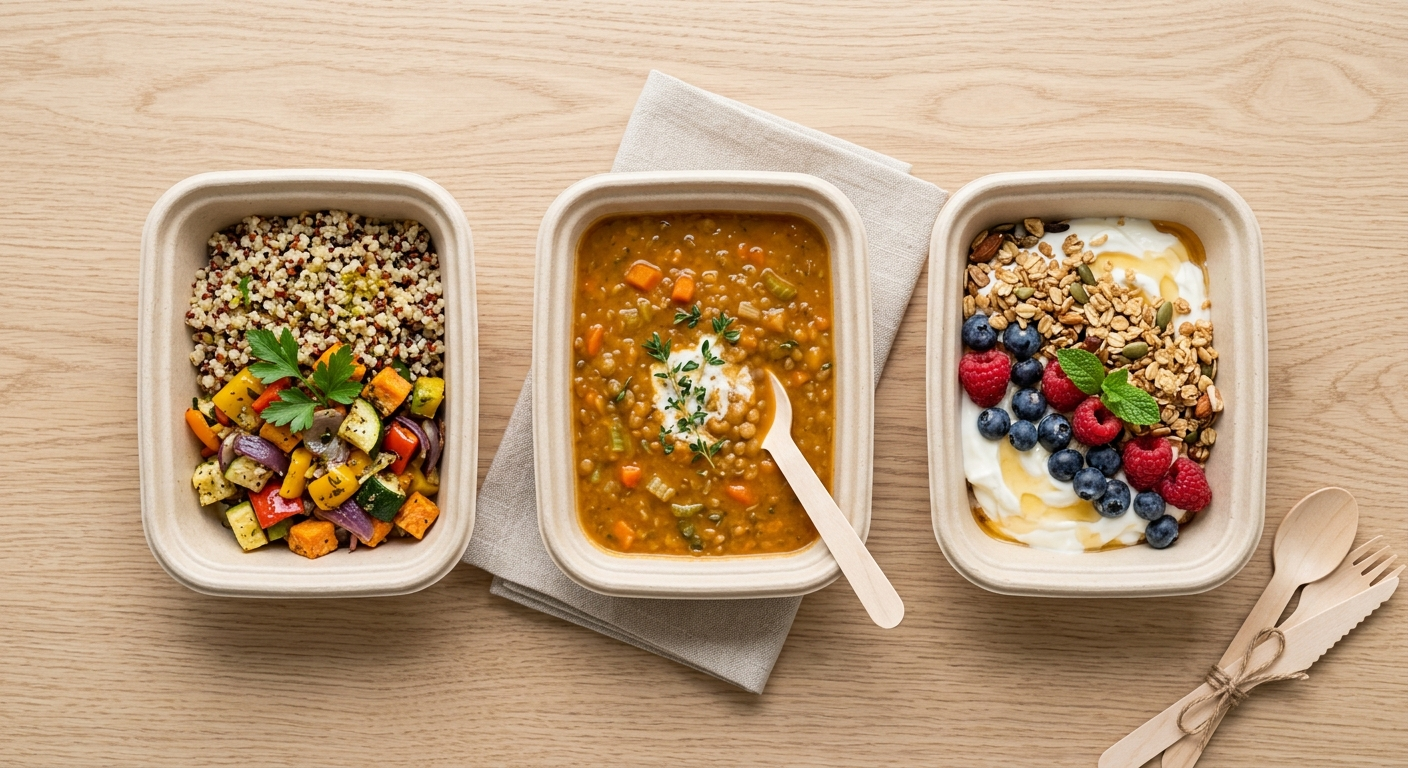
The 8oz container serves sides, desserts, and sauces. Research from the Culinary Institute of America indicates that 6-7oz is the optimal side dish portion for balanced meals. Our 8oz bagasse bowls are microwave-safe and handle both hot and cold applications.
Typical portions: Mac & cheese (6oz), coleslaw (5oz), soup as a side (7oz), rice (5oz cooked), desserts (6oz).
12oz: The Lunch Portion
12 fluid ounces = 1.5 cups = 355 ml
According to USDA dietary guidelines, a standard lunch entrée ranges from 10-12oz. The 12oz container provides adequate headspace while maintaining portion control. This size works particularly well for wooden cutlery pairings in lunch combos.
Typical portions: Soup (10-11oz), chili (9oz), small grain bowl (10oz), pasta salad (9oz).
Calculator Tip: Not sure if 12oz or 16oz fits your recipe? Our Culinary Converter calculates volume from ingredient lists and recommends the optimal size.
16oz: The Industry Standard
16 fluid ounces = 2 cups = 473 ml = 1 US Pint
The 16oz container represents 65% of takeaway entrée orders in the US food service market (National Restaurant Association, 2025). It balances portion satisfaction with cost efficiency. Our 16oz kraft containers offer excellent value for standard mains.
Typical portions: Pasta with sauce (13oz), stir-fry with rice (14oz), curry (12oz), large soup (14oz).
24oz: The Large Format
24 fluid ounces = 3 cups = 710 ml
The 24oz size accommodates dishes requiring extra volume - particularly salads (which compress) and noodle soups (which need broth space). Studies show customers perceive better value when containers are 75-85% full rather than 50-60% full, even with identical portions.
Typical portions: Poke bowl (20oz), large salad (18oz), noodle soup (22oz), meal prep entrée (20oz).
32oz: The Family Size
32 fluid ounces = 4 cups = 946 ml = 1 Quart
The 32oz container serves family-style portions or soup-heavy dishes. For Vietnamese pho or ramen, this size provides proper broth-to-noodle ratio. Our 32oz bagasse containers are certified compostable and handle temperatures up to 200°F.
Typical portions: Pho (28oz), large poke bowl (26oz), family pasta (28oz), bulk sides (28oz).
Measurement Conversions for Food Service
Understanding volume conversions ensures accurate portioning and cost control:
Liquid Measurements (soups, sauces, broths):
Ounces | Cups | Milliliters | Common Use |
|---|---|---|---|
8 oz | 1 cup | 237 ml | Side soup, sauce |
12 oz | 1.5 cups | 355 ml | Lunch soup |
16 oz | 2 cups | 473 ml | Main soup, curry |
24 oz | 3 cups | 710 ml | Large soup |
32 oz | 4 cups | 946 ml | Pho, ramen |
Solid Foods (volume-to-weight ratios per USDA FoodData Central)
Food Type | 1 Cup Volume | Weight | Grams |
|---|---|---|---|
Cooked rice | 1 cup | 5.5 oz | 155g |
Cooked pasta | 1 cup | 4.9 oz | 140g |
Salad greens | 1 cup | 1.2 oz | 34g |
Stir-fry vegetables | 1 cup | 5.3 oz | 150g |
Need exact calculations? Our Culinary Converter handles both liquid and dry ingredient conversions, accounting for density differences automatically.
Choosing Sustainable Container Materials
With single-use plastic bans expanding globally, material selection impacts both compliance and brand perception. Here's what the data shows:
Bagasse (Sugarcane Fiber):
Composts in 60-90 days per ASTM D6400 standards
Microwave-safe up to 200°F
Cost: $0.15-0.25 per 16oz unit
Our bagasse containers are FDA-approved and PFAS-free
Kraft Paper:
Composts in 90-120 days
Best for dry or semi-dry foods
Cost: $0.12-0.20 per 16oz unit
Our kraft containers use FSC-certified paper
Environmental Impact (per 1,000 units):
Plastic containers: 2,190 kg waste, 500+ year decomposition
Compostable containers: 1,825 kg organic waste, 60-90 day decomposition
The cost difference averages $0.06 per container - less than 0.5% of a typical $12 entrée price.
Common Sizing Mistakes to Avoid
Mistake 1: Overfilling Containers
Filling to 100% capacity causes spills and poor presentation. Research shows customers perceive 75-85% fill as more generous than 100% fill due to visual appeal and ease of handling.
Mistake 2: Using One Size for All Items
A 2024 food service study found that restaurants using 2-3 container sizes reduced packaging costs by 12-18% compared to single-size operations, while improving customer satisfaction scores.
Mistake 3: Ignoring Material Properties
Not all materials handle all foods. Bagasse excels with hot liquids, kraft paper suits dry foods, and PLA fails above 110°F. Match material to application.
Solution: Test samples with your actual menu items before bulk ordering. We provide free sample kits - request yours here.
Using the Culinary Converter Tool
Our Culinary & Operations Converter eliminates guesswork:
Input your recipe - Enter ingredients and quantities
Get size recommendation - Tool calculates total volume plus headspace
Compare options - See fill percentages for different container sizes
Calculate costs - Factor in food and packaging costs per portion
The tool accounts for ingredient density, headspace requirements, and industry standards from USDA and FDA guidelines.
Calculate your perfect container size now: Culinary Converter Tool
Need Quality Containers?
ToGoTableware specializes in compostable food service packaging. Our bagasse containers are microwave-safe and handle temperatures up to 200°F. For cold applications, our kraft containers offer excellent value with FSC-certified materials.
All products are FDA-approved, PFAS-free, and certified compostable per ASTM D6400 standards. Pair with our wooden cutlery for a complete sustainable solution.
Request free samples to test with your menu items before ordering.
Common Questions About Takeaway Container Sizes
How do I know what size container I need?
Measure your actual portion size, then choose a container 15-25% larger. For 12oz of pasta, use a 16oz container. Use our Culinary Converter for exact calculations.
What's the difference between fluid ounces and dry ounces?
Fluid ounces measure volume (space), dry ounces measure weight. Containers use fluid ounces. An 8oz container holds 8 fl oz (1 cup/237ml) of liquid, but weight varies by ingredient.
Can I use the same container for hot and cold foods?
Bagasse containers work for both. Kraft paper suits cold/room-temperature foods. PLA melts above 110°F - avoid for hot foods.
How much should I fill a container?
Aim for 75-85% full. This prevents spills, looks generous, and makes eating easier. Filling to 100% causes squishing and leaks.
What size container is best for soup?
Side soup: 8-12oz. Main dish soup: 16oz. Large/family portions: 24-32oz. Always leave 1 inch headspace to prevent spills.
Can customers microwave these containers?
Bagasse: Yes, microwave-safe. Kraft paper: Not recommended for liquids. PLA: Will melt. Check specifications before use.
Ready to find your perfect container size?
Use our free Culinary & Operations Converter - no signup required.
Related Resources
Oz to Cups Conversion Guide - Complete measurement reference
How Many Cups is 12 oz? - Standard lunch portions
How Many Cups is 16 oz? - Main dish sizing
Culinary Converter Tool - Calculate container sizes
Sustainability Calculator - Environmental impact